On-Page SEO For Law Firms

Get Found Faster with On-Page SEO for Law Firms

Gracie L.
"I’ve been working with Blue Media on SEO for my business’ website and after a few months of implementing their recommendations and strategies, leads tripled and business doubled!"
Book a Free SEO Audit
Get your free 1-hour site audit.

Trusted by 200+ clients

Happy Clients To Date
0 +
SEO Firm for lawyers*
# 248
revenue generated*
$ 0 M+
On-Page SEO For Lawyer

How Blue Media Marketing Law Can Help with Law Firm On-Page SEO

Your website is, in many cases, a client’s first “meeting” with your firm. If the structure, layout, or wording are confusing, potential clients will often click away before reaching out for a consultation. 

Before you can rank for competitive terms like “personal injury lawyer” or “divorce attorney,” your site’s foundation must be solid: clear page titles, helpful content, intuitive navigation, and a fast, mobile-friendly experience.

Unlike off-page or local SEO where you focus on external reviews and backlinks, on-page SEO for law firms is about optimizing what you can on your own domain. The scope includes the content you publish, how your pages are coded, and how easily people and search engines understand what you do. Because you fully control these elements, they are often the fastest and most reliable levers to improve visibility and conversions.

Blue Media Marketing Law acts as the architect behind high-performing legal websites, blending technical best practices with clear, empathetic messaging. The result is a site that satisfies Google’s quality expectations for legal content and reassures real clients that they are in the right place. Our law firm SEO services build on that foundation, optimizing websites for rankings, leads, and new clients.

What Is On-Page SEO for Law Firms?

On-page SEO for law firms means optimizing each page so that it clearly communicates its topic, serves the user’s needs, and is easy for search engines to interpret. It focuses on the words on the page, the behind-the-scenes HTML fields (like titles and headings), and aspects of user experience such as layout, readability, and calls-to-action.

Legal websites also fall under Google’s “Your Money or Your Life” (YMYL) category, which includes content that can impact a person’s safety, finances, or freedom. Because of this, law firm pages are held to stricter standards of accuracy, clarity, and trust than many other industries. Google looks for signals of real-world experience, legal expertise, authority, and trustworthiness (often referred to as E-E-A-T) when evaluating law firm content.

Every page must serve two audiences at once: 

  • The first one is the human reader, who may be scared, stressed, or confused and needs plain-English explanations and a clear path for help from your firm. 
  • The second one is the search engine, which needs clear signals such as keywords, structured layouts, and schema markup in order to understand what the page is about.

Core On-Page Elements: The "Big Three"

Schema Markup

Title Tags & Meta Descriptions

The title tag is the clickable headline that appears in Google’s search results. For law firm websites, it is often the single most important on-page element for rankings and click-through rate (CTR). An effective title tag front-loads the most critical keywords and clearly states the service and location. Employing an optimized structure helps search engines understand the page quickly, and reassures users that you can handle their case type.

Meta descriptions do not directly control rankings, but they function as your “sales pitch” in search results, strongly influencing whether or not someone clicks on your listing. A great meta description uses phrases that the clients care about such as “free consultation,” “24/7 availability,” or “experienced trial lawyer.” 

Together, strong titles and meta descriptions improve both visibility and click-through rate, which supports overall performance. As part of an on-page effort, we will audit and re-write all of your title and meta descriptions, tailoring them to align with your customer base and business goals.

Content Marketing

Header Tags (H1, H2, H3)

Header tags are the “chapter headings” on a page. They help break up complex legal topics into logical sections and make the content easier to scan. Each page should have exactly one H1 tag which is the main page heading that reflects the core topic. Subheadings (H2s, H3s, etc.) then organize key information into subtopics, breaking up walls of text and adding some much needed organization to otherwise confusing topics.

Hierarchy is also important as headers create an outline for your content: H1 is the main title, H2s are major sections, and H3s are subsections under an H2. Think of header tags as nesting dolls; the smaller headings sit within the bigger one.

Proper heading structure helps potential clients quickly find the information they care about. It also helps search engines, as bots crawl header tag text to gain context on what the page is about. As part of an on-page SEO effort, our team will audit all of your existing content for proper header structure, hierarchy, and relevance.

URL Structure

Clean, descriptive URLs give both users and search engines another clue about what a webpage is about. Instead of generic URLs like “/page1,” law firm sites benefit from descriptive paths. Logical URL silos also help search engines see how core topics and sub-topics relate to each other. Take for example: 

  • /practice-areas/
    • /practice-areas/family-law/
    • /practice-areas/criminal-defense/
      • /practice-areas/criminal-defense/domestic-violence/
      • /practice-areas/criminal-defense/dui/


This structure is an intuitive way to organize content and stands to improve both navigation as well as help the search engine understand broad service areas and the more niche specialized services within that topic.  

Optimizing URL structure is one of the top on-page techniques for improving relevance and visibility. As part of an ongoing effort, our SEO team will review your current structure and recommend ways to better organize your content. In some cases, we will create new webpages and redirect the old to the new, supporting a seamless transition along the way.

Content Optimization: E-E-A-T for Lawyers

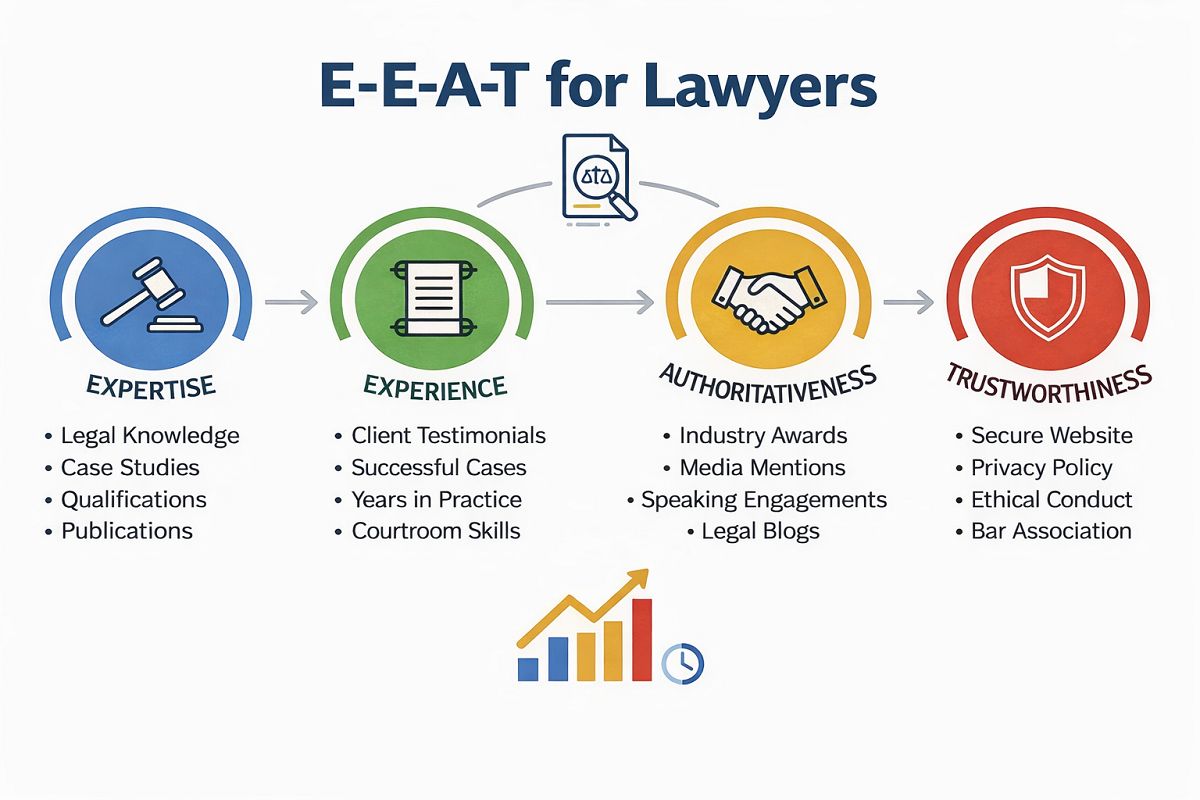
Law firm content can’t get away with simply mentioning a keyword, it needs to demonstrate depth of knowledge, proper credentials, and make visitors feel safe. E-E-A-T is a core component of on-page SEO for law firms:

  • Experience & Expertise: Attorney bios, bar admissions, case results, years in practice, awards, and recognizable credentials all help convey that your team is qualified to discuss a topic and handle cases in that area.
  • Authoritativeness: Law firm SEO works best when you demonstrate depth. Ditch the short-form generic blog posts and focus on comprehensive guides that fully answer the core questions. 
  • Trustworthiness: Within the legal space, you have an obligation to your visitors to provide them with clear disclaimers, distinguish between general information and legal advice, and ensure their experience is secure with HTTPS protocols.

As part of an on-page SEO project, Blue Media will weave elements of E-E-A-T throughout all key pages, not just on a standalone “about” page. We will also audit and revamp existing content, ensuring that it’s robust and shows depth of knowledge. This will serve to prove to search engines that you’re a worthy firm to be ranked, while encouraging your website visitors that they can put their trust in you.

Internal Linking: Building the "Legal Web"

Internal links are links that originate on one of your webpages, directing to another one of your webpages, and they are powerful tools that many firms underuse. Internal linking helps visitors discover related content and ensures search engines understand which pages are most important. Linking from high-authority pages (such as your homepage or major practice area pages) to deeper pages on more specific subtopics and niches, passes value and can improve visibility more broadly across your website. 

Think of it like a “web” on a certain topic: Your comprehensive guide on family law should link out to all of the related content such as prenuptial agreements, child visitation, grandparent’s rights, etc. In return, these subtopics should also link back to the main guide. All of the content on this topic should point to the conversion page, or the main service type landing page.

Thoughtful internal linking supports both navigation and search understanding. Our SEO team will work to ensure that all critical pages are linked in high value areas such as the navigation and footer with optimized anchor text. We will also audit landing pages and editorial content to begin forming topical hubs, which we will then ensure are all tied together through an internal linking strategy.

Technical On-Page Factors

Image Optimization

Images add personality and clarity to legal pages, but if they are not optimized they can slow down your site dramatically. Compressing file sizes and using modern formats helps pages load faster, which improves user experience and can positively influence rankings. Alt text, the short description attached to images, is also important. It helps visually impaired users understand the image and gives search engines extra context. 

Page speed and load times are a direct ranking factor and critical for user experience, while a well-written alt text is a subtle but important part of on-page relevance. In order to improve on both, a complete image audit and optimization project will be a built-in part of any on-page SEO effort.

Schema Markup (Structured Data)

Schema markup is code added behind the scenes that is written in the language that search engines understand best, and it explains what different parts of your site represent. For law firms, schema types such as LegalService, Attorney, LocalBusiness, BreadcrumbList, and FAQPage implemented on corresponding page types can help search engines display your pages with rich features like star ratings, breadcrumb trails, or FAQ dropdowns on the search results page. 

While clients never see schema directly, it can improve how your listings appear and expand the real-estate that you capture in search results. Schema requires careful implementation to avoid errors, so working with a specialized team is important.

Mobile Responsiveness & UX

More and more legal searches happen on non-desktop devices such as mobile phones and tablets. Mobile-responsive design ensures your site adjusts smoothly to different screen sizes, making menus, contact buttons, and content easy to use with a scrolling thumb. Important actions like “Request a Consultation” should be clearly visible and easy to tap without zooming. 

It’s important to mention that Google’s “mobile-first” rule, known as Mobile-First Indexing, means Google primarily uses the mobile version of a website for indexing and ranking, meaning this is a direct ranking factor. Our SEO team will audit and optimize your website across all screen sizes and device types, ensuring fast performance, clear readability and seamless navigation.

What people say about us
Don't just take it from us
Keyword growth for Los Angeles personal injury law firm
0 +
Traffic growth monthly for Texas Property & Insurance claim law firm
0 +
Form submission growth monthly for Ohio bankruptcy law firm
0 +

How Blue Media Marketing Law Perfects On-Page SEO

Case Studies

La Liga Defensora
Headquartered in Los Angeles, California
Traffic Increase
0 %
Curan & Ahlers LLP
Headquartered in White Plains, New York
Traffic Increase
0 %
North County Immigration
Headquartered in San Diego, California
Traffic Increase
0 %
FAQs About Law Firm On-Page SEO

Practice area pages should be treated as living documents. Updating them at least a few times per year with new case examples, recent law changes, fresh FAQs, and improved explanations keeps them accurate, relevant, and aligned with how clients search. 

Tip: Keep your eye out for key events in the world, the news, and across social media. If there is a relevant topic or question that is popping up, add a dedicated section within the corresponding practice area page. This will help you capture spikes in keyword volume for curiosities that arise among your client base!

Word count alone is not a ranking factor, quality and completeness are what matter most. However, thin content is the enemy of ranking systems – not providing enough context, information, or answering top relevant questions will guarantee the top spots in search are saved for your competitors. Conversely, writing more just to boost word count without actually adding depth will result in poor engagement signals that tell Google your content isn’t helpful. Put yourself in your client’s shoes and ask yourself: does this content instill confidence and answer all the questions someone might have on your topic? If it does, then you’re probably on the right track.

AI tools are great resources to help with parts of the writing process such as outlines or idea generation, but relying on them for final content is risky. LLMs can “hallucinate” facts, misstate laws, or produce generic wording that falls short of YMYL standards. All legal content should be written, reviewed, corrected, and customized by an attorney or qualified legal writer. 

Additionally, in the era of AI, don’t forget the importance of the human experience. Your clients may be stressed, overwhelmed, and scared as they face their legal challenge. While information is the #1 priority, it’s not always what you say but how you say it. Be sure to instill confidence, trust in a way that says “we’ve got this.”
The title tag is what appears in search results and the browser tab while the H1 is the main on-page heading visitors see at the top of a page. They should be closely related, but they serve different purposes and both need to be optimized thoughtfully.

High traffic with low conversion often signals an on-page mismatch: the wrong audience, unclear messaging, weak calls-to-action, or content that does not align with what searchers actually need. Reviewing titles, headings, page layout, and conversion steps for intent alignment is a key part of improving results. There are also technical aspects that could be causing low conversions such as poor performance or bad mobile experience. Typically, there isn’t just one single thing. A good SEO partner can help diagnose all of the friction points that are throttling your growth and create a plan of action to fix them.

Ready To See How Technical SEO Can Transform Your Law Firm's Website?

On‑page SEO for law firms is not about chasing every technical detail, it is about building clear, trustworthy pages that answer real client questions and make it easy to take the next step. With Blue Media Marketing Law as your partner, your firm can turn its website from a static brochure into a high‑performing asset that attracts the right visitors, earns their trust, and converts them into clients.

Law Firm SEO

Types of Law Firms We Serve