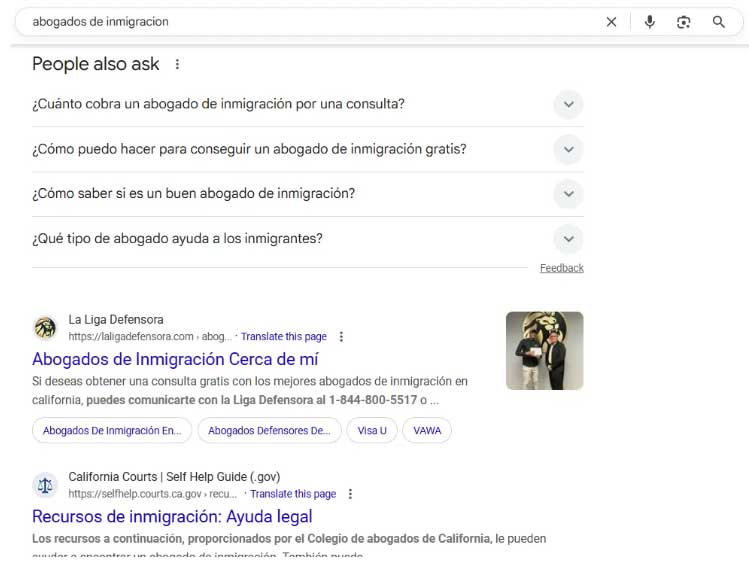
Our proven strategies help law firms consistently climb Google’s search results, putting your name where it matters most—at the top of page one.
By targeting high-intent keywords, we connect your firm with people who are actively seeking legal help, not just browsing information.
Optimized local SEO ensures your firm stands out in map results, local directories, and city-specific searches—driving more walk-ins and calls from nearby clients.
Unlike paid ads, which stop the moment you pause spending, SEO provides compounding returns. The work we do today lays the foundation for future traffic and leads.
High-quality content, reviews, and backlinks establish your firm as a trusted authority in your area of law, encouraging clients to choose you over competitors.
SEO offers one of the best returns on investment in digital marketing. Once rankings are established, the cost per lead drops significantly compared to PPC.
Search engines reward sites that offer fast load times, easy navigation, and mobile responsiveness—all of which also create a better experience for your clients.
With clear calls-to-action, intuitive design, and optimized landing pages, our SEO approach turns more website visitors into consultations—boosting your firm’s bottom line, not just traffic numbers.
We continuously track rankings, user behavior, and keyword performance to refine your strategy—ensuring your firm stays ahead of competitors and adapts to ever-changing search trends.
At Blue Media Legal SEO In San Diego, we help law firms cut through the noise and dominate search results with proven search engine optimization (SEO) strategies tailored to your practice. In today’s world, clients use the internet to validate the reputation of word-of-mouth recommendations and or to find the exact service they need. Potential clients in need of legal services will likely pull out their phone, type “best divorce lawyer near me” or “top criminal defense attorney in Dallas,” and click the firms they see first.
If your law firm isn’t showing up on page one, you’re invisible to the very people actively searching for your services. That’s where we come in. Our team has developed a process specifically for attorneys and law firms that balances technical expertise, powerful content, and local optimization to bring you measurable results: higher rankings, more client calls, and sustainable growth.
Whether you’re a solo practitioner, a boutique firm, or a multi-office practice, Blue Media Law tailors SEO campaigns that align with your goals and budget. We don’t just chase traffic — we focus on the clients who matter most.
Law firm SEO is the art and science of making your firm’s website rank higher in Google and other search engines. Done right, it ensures that when potential clients search for legal services in your area, your firm appears front and center – like a trusted leader in the marketplace.
Unlike generic SEO, which may target broad audiences, law firm SEO zeroes in on high-intent, location-specific keywords. For instance:
These are searches from people ready to call a lawyer. Strong SEO also involves creating helpful content, building online authority, and ensuring your site provides a seamless user experience. It’s about earning trust with both search engines and potential clients.
When done properly, SEO becomes one of the most cost-effective, long-term strategies for client acquisition — delivering results long after ads stop running.
Getting a law firm to perform better in search requires a close look at the website, the market, and the types of clients the attorneys actually want to represent. At Blue Media Marketing Law, our SEO services cover research, technical improvements, content development, local optimization, and ongoing campaign management.
The work varies by firm. A practice with hundreds of existing pages might need technical corrections and better organization before investing in new content. A newer firm may have a functional website but very little information about the legal services it offers. We evaluate those differences when determining where to focus.
Before recommending keywords or creating pages, we examine which legal services your firm wants to promote and where those clients are searching. That involves researching search terms, examining competing law firms, and identifying opportunities based on the matters your attorneys handle.
Search intent matters. Someone researching the divorce process may need general information, while someone searching for a divorce attorney in a particular city may be closer to scheduling a consultation. Both searches can have a place in an SEO strategy, but they serve different purposes.
Our research informs a keyword-to-page plan identifying which existing pages should target specific searches, where content is missing, and which opportunities deserve attention first.
Typical output: Keyword research, competitor findings, and a prioritized keyword-to-page plan.
Your practice-area pages should explain what your firm handles, who it represents, and why a prospective client should feel comfortable contacting you.
We review existing pages for opportunities to improve titles, meta descriptions, headings, content organization, and internal links. We also consider how visitors move through the website. A page that attracts the right audience but makes it difficult to find attorney credentials or request a consultation may need more than keyword adjustments.
We don’t recommend creating a new page for every search variation. Sometimes strengthening an existing service page is the better use of the firm’s budget.
Typical output: Optimized service-page content, improved metadata, internal-link updates, and recommendations for additional pages where necessary.
Technical problems can prevent otherwise useful content from reaching its intended audience. Pages may be difficult for search engines to discover, important URLs may redirect incorrectly, or multiple versions of similar content may cause indexing problems.
Our technical SEO services for law firms address issues involving crawlability, indexing, redirects, canonical tags, website architecture, and performance.
A technical review identifies problems affecting the website and helps determine which corrections should happen first. Some fixes can be addressed directly through the site’s content management system. Others may require development work, particularly when the problem involves templates, navigation, or sitewide functionality.
Typical output: Documented technical findings, prioritized recommendations, and implemented fixes within the agreed campaign scope.
A legal website needs content that reflects the firm’s services and answers the questions prospective clients have before contacting an attorney.
Our law firm content marketing services support the development and optimization of service pages, informational articles, FAQs, and other relevant resources. We select topics based on search research, existing website coverage, and the firm’s business priorities.
Legal accuracy requires particular attention. Your designated attorneys should review and approve jurisdiction-specific explanations, descriptions of legal services, and substantive legal statements before publication. Blue Media develops content from a marketing and search perspective, while the firm remains responsible for approving its legal accuracy.
We also assess existing material to identify pages that need substantial revisions, consolidation, or factual updates.
Typical output: Content plans, completed drafts, revised practice-area pages, and recommendations for maintaining established content.
For firms serving a defined geographic market, local search visibility deserves attention alongside traditional organic rankings.
Our local SEO services for law firms address Google Business Profile optimization, business information consistency, relevant directory listings, reviews, and location-focused website content.
We examine whether the firm’s business information accurately reflects its real offices and services. We also consider how potential clients evaluate local search results, including the information and reviews available before they reach the website.
Location pages can support this work when they serve a genuine purpose. A firm representing clients across several communities may need to explain its geographic reach, but creating nearly identical pages for every neighboring city rarely provides a compelling experience.
Typical output: Business profile improvements, citation corrections, location-content recommendations, and guidance on developing an appropriate review process.
Links from other websites can help search engines discover content and provide signals about a website’s relevance. For law firms, the quality and context of those connections deserve considerably more attention than the total number of links acquired.
We evaluate existing backlinks, relevant legal and local directories, and competing websites as part of our off-page analysis. This helps identify gaps and opportunities for developing a stronger online presence.
Link opportunities should make sense for the practice and its market. A credible local organization or established legal resource may provide more useful exposure than a collection of unrelated websites offering links with little editorial value.
Specific outreach or link-acquisition activities depend on the campaign scope and the opportunities identified through research.
Typical output: Backlink findings, authority-development recommendations, and documented off-page optimization work.
SEO involves decisions that need to be revisited as the website improves and the competitive environment changes.
Blue Media provides monthly reporting on keyword rankings, website traffic, and lead-generation performance. Our broader agency also describes dedicated SEO specialists, ongoing optimization, conversion-tracking setup, and recurring campaign discussions.
These activities help connect initial research with continued execution. A campaign roadmap establishes priorities, while reporting provides evidence for deciding whether those priorities should change.
Clients should be able to understand which areas received attention, what the available performance data shows, and which activities are planned next.
Typical output: Monthly SEO reports, progress documentation, and an updated list of campaign priorities.

Two law firms can operate in the same city, offer similar services, and need very different SEO strategies. Their websites may have different technical problems, their strongest practice areas may already rank for valuable searches, and their opportunities for improvement may be concentrated in entirely different places.
That’s why we begin by establishing what your firm already has before deciding what to build.
We examine the condition of your website, the visibility of its existing pages, your target geographic markets, and the practice areas you want to develop.
Google Search Console, available analytics, keyword rankings, and a technical review help establish that starting point. We also look at whether conversion tracking is functioning well enough to evaluate inquiries attributed to organic search.
A firm with existing search visibility may have valuable opportunities hidden in pages that are underperforming. For another firm, basic technical corrections or missing practice-area content may be the immediate concern.
Search volume alone doesn’t tell us which keywords deserve investment.
We consider the relevance of each search to your legal services, the competition in your market, the strength of existing pages, and the work required to pursue the opportunity.
A lower-volume search tied to a specific matter your firm wants to handle may deserve attention before a much broader term. Existing pages already appearing in search results may also present opportunities for improvement without requiring an entirely new content investment.
Once we understand the opportunities, we organize the work around practical dependencies.
If important pages cannot be indexed properly, resolving that problem may take priority over producing additional content. If technical conditions are sound but the website lacks essential practice-area information, content development may move higher on the list.
The roadmap can include technical fixes, existing-page improvements, new content, internal linking, and off-page authority work. The order depends on what will address the firm’s most pressing limitations.
Blue Media’s broader SEO operations also include site-structure development, SEO content strategy, roadmap execution, and ongoing optimization. Those activities provide the practical foundation for turning recommendations into completed website improvements.
As the campaign develops, we examine ranking changes, search impressions, organic traffic, and available inquiry data.
These findings help us determine which improvements are gaining traction, where competitors remain stronger, and which pages need further attention.
An established page might improve after content revisions but still receive relatively few inquiries. That could justify reviewing the page’s search intent, presentation, or consultation process before investing in additional traffic.
The next round of work should reflect what we’ve learned rather than simply repeating the original plan.
Consider an established personal injury firm with dozens of service pages. Its website receives organic traffic, but several important pages rank below competing firms. An initial campaign might prioritize technical issues, stronger page content, and improvements to internal linking.
Now consider a newly established family law firm with only a homepage and contact page. Its immediate needs are different. The first priorities may be developing useful divorce and custody service pages, establishing accurate local business information, and making it easy for prospective clients to contact the firm.
These are hypothetical examples, not actual Blue Media campaign results. They illustrate why the same monthly checklist would be inappropriate for both firms.
A ranking improvement is useful to know about. Whether that improvement contributes to additional business requires a closer look.
At Blue Media Marketing Law, our monthly SEO reporting covers keyword rankings, website traffic, and lead-generation performance. We use those measurements to understand how your website is performing and where the campaign needs attention.
We examine where your website appears for relevant searches and how visitors reach its pages through organic results.
Metrics such as search impressions, keyword rankings, clicks, and organic landing-page performance help us identify whether the website is gaining visibility in important practice areas.
A page can receive more impressions without attracting more visitors, and increased traffic may come from searches unrelated to the firm’s preferred matters. We consider those distinctions when interpreting performance.
Changes in rankings also need context. A movement for a relatively obscure informational keyword may be less commercially significant than improved visibility for an important service page.
Calls and contact form submissions provide a more direct indication of prospective client interest.
Where appropriate tracking is available, we can examine inquiries attributed to organic search and identify which landing pages are associated with those interactions.
Raw inquiry counts still need context. Spam submissions, questions about services the firm doesn’t offer, and inquiries from outside its intended markets can inflate lead totals.
If the firm maintains lead qualification information, that feedback can help establish whether additional traffic is reaching the right audience.
Our conversion-tracking work helps improve visibility into website inquiries, subject to the tracking methods and reporting access included in the engagement.
Signed matters provide an important measure of marketing’s business impact, but they require information that isn’t ordinarily available from website analytics alone.
Reliable analysis depends on the firm’s intake or CRM records, consistent lead-source information, and an agreed method for connecting inquiries with later outcomes.
When that information is available and included in the engagement, it can help inform campaign decisions. Without it, we distinguish tracked website inquiries from consultations and signed clients rather than treating them as interchangeable.
This distinction is particularly important for practices where an initial inquiry may lead to several conversations before a representation agreement is signed.
A useful monthly review should answer several practical questions. What work was completed? Which pages or keywords improved? Where did performance decline or remain unchanged? What does the available data suggest about the next priority?
Our goal is to make those conversations specific. A traffic increase deserves interpretation, just as a disappointing month deserves a clear explanation of what the data does and doesn’t establish.
Blue Media’s campaign management combines monthly SEO reporting with ongoing optimization and progress reviews. Those discussions should connect search performance to the work being completed and the next set of recommendations.
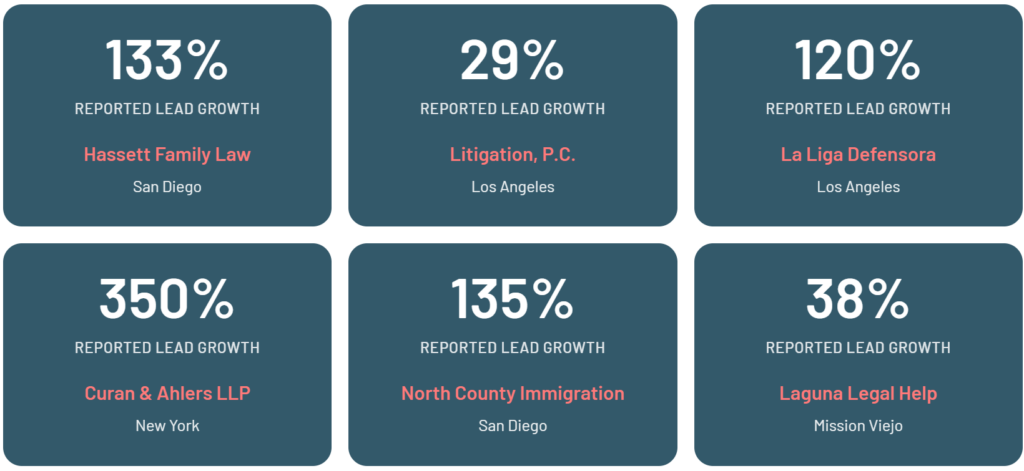
Blue Media’s broader legal marketing portfolio includes the following published results.
These are reported lead-growth figures from Blue Media’s legal SEO portfolio. They should be presented as individual client results, rather than an average or guaranteed outcome for future campaigns.
The first chart shows website sessions rising from 11 in February to 1,054 in June, following a marked SEO campaign launch in February. Blue Media reports a 9,481% increase in sessions over four months.
The website had recorded relatively little traffic before the campaign. The chart illustrates substantial growth from a small starting base.
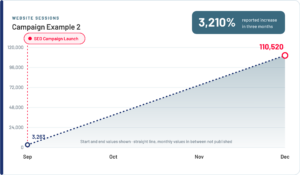
The second chart shows monthly sessions rising from 3,263 in September to 110,520 in December. Blue Media labels this result as a 3,210% increase over three months.
The chart also shows that traffic had remained comparatively stable during the months preceding the reported campaign launch, followed by a pronounced increase.
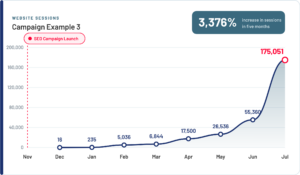
The third chart shows sessions rising from 5,036 in February to 175,051 in July. Blue Media reports 3,376% growth over five months and describes the example as involving an investor-backed company with a substantial marketing budget.
These charts show different campaign circumstances and starting traffic levels. The source material does not identify the clients, calendar years, traffic channels included in sessions, or the extent to which other marketing activity contributed to the reported changes.
A law firm with a small website, limited existing search traffic, and several missing practice-area pages may experience a very different campaign trajectory from a well-established firm competing for difficult keywords.
These published results demonstrate what Blue Media reports accomplishing across its client portfolio. When considering an SEO engagement, the more useful question is how your website’s present condition, competitive market, and business priorities compare with the circumstances behind those results.
Our law firm SEO services begin with evaluating those conditions and identifying where the work should be focused.
At Blue Media SEO for Law Firms in San Diego, we specialize in law firm marketing backed by proven strategies and a comprehensive understanding of the industry. That means we know how to navigate:
We’re more than SEO specialists — we’re growth partners who understand the unique challenges law firms face in attracting clients.
A law firm rarely values every inquiry equally. A personal injury practice might focus on a particular category of serious injury claims, while a family law firm may want to expand its divorce practice without increasing inquiries about unrelated matters.
Your SEO campaign should account for those priorities when selecting keywords, improving pages, and developing supporting content.
Broad searches such as “personal injury lawyer” or “family law attorney” can introduce prospective clients to a practice. More specific searches often reveal the nature of the legal problem. Someone searching for a commercial truck accident attorney has a different question than someone looking for general information about injury claims.
For personal injury law firm SEO, that distinction can shape how the website organizes accident types, injuries, attorney experience, and related resources. A firm that handles truck collisions may benefit from a well-developed page explaining that representation, supported by articles addressing common questions following those accidents.
A family law SEO strategy may require a different structure. Divorce, child custody, and modifications involve related but distinct client concerns. Each may warrant its own service page if the firm handles those matters and there is enough substance to justify separate coverage.
Supporting articles and FAQs help explain relevant legal issues, while internal links guide readers toward the appropriate service pages. Geographic targeting also plays a role, particularly when the firm’s actual offices and service markets affect which prospective clients it can reasonably serve.
Feedback from your intake team adds another useful perspective. If the website attracts inquiries about matters your firm doesn’t accept, or prospective clients routinely misunderstand a service, that information can help guide future page revisions.
A well-directed campaign considers what happens after the search, including whether visitors understand the services available and can reach the right person at your firm.
Most firms begin to see results within 3–6 months, though the exact timeline depends on factors like your competition, location, and the current state of your website. For example, if you’re a personal injury attorney in a major metro area, ranking can take longer due to the sheer number of competitors. Smaller markets often see quicker wins, especially with local SEO. It’s important to remember that SEO is a long-term strategy. Rankings build gradually, but once established, they provide ongoing visibility that continues paying dividends even if you dial back your investment. The best firms treat SEO as an essential part of their marketing engine, not a one-time project.
PPC (pay-per-click) ads, such as Google Ads, provide instant visibility at the top of search results. The downside is they stop driving leads the moment you stop paying. SEO, on the other hand, is about building organic authority so your site earns its place in rankings. Many firms see the best results by combining both. PPC drives fast results while SEO builds long-term equity. For example, a criminal defense attorney may run PPC ads for “DUI lawyer near me” while simultaneously investing in SEO for broader terms like “best criminal lawyer in Dallas.” This balanced approach captures both immediate and ongoing demand.
Absolutely. In fact, SEO often levels the playing field for small and solo attorneys. While large firms may have big advertising budgets, SEO allows smaller practices to compete locally by targeting specific niches and neighborhoods. A solo family lawyer in Denver, for instance, could target searches like “child custody lawyer Denver Highlands” or “divorce lawyer near Capitol Hill.” By focusing on local intent and long-tail keywords, smaller firms can secure consistent leads without needing the marketing budget of a national practice.
Reviews are one of the most powerful ranking factors in local SEO. Google Business Profiles with a steady stream of positive reviews often rank higher in the map pack. Beyond rankings, reviews also build client trust. Many people won’t even call a lawyer without reading testimonials first. We work with law firms to develop ethical, consistent review-generation strategies—encouraging happy clients to share their experiences, while also helping firms manage and respond to reviews professionally. The combination of volume, quality, and responsiveness shows both Google and potential clients that your firm is trustworthy.
Yes. High-quality, keyword-optimized content is the backbone of SEO. For law firms, this goes beyond simple blog posts—it means creating resources that answer client questions, explain legal processes, and build authority in your practice area. For example, an immigration attorney might publish a step-by-step guide to applying for a green card, while a personal injury lawyer could produce an FAQ on what to do after a car accident. The more valuable your content, the more likely clients are to find it, share it, and trust your expertise. Content marketing not only improves rankings but also establishes you as the go-to authority in your field.
At Blue Media Marketing Law, we provide SEO services for law firms throughout the United States. We are located in the San Diego County area and have many clients in Southern California such as Chula Vista, Oceanside, Carlsbad, and much more. In fact, we also have attorneys in Los Angeles that serve clients in many different cities throughout the U.S.
We’re experts when it comes to legal SEO and are here to drive leads for all types of law.