








Law Firm SEO
Case Studies & Results
Your law firm's website should be helping prospective clients find your attorneys, understand your services, and take the next step toward contacting your office.
At Blue Media Marketing Law, we've helped legal practices improve their online visibility and generate more inquiries through targeted search engine optimization. Our published results include law firms in San Diego, Los Angeles, and New York, with measurable improvements in search rankings, website traffic, and lead generation.
Explore how our clients have performed and what those results can tell you about the opportunities available for your own firm.
Real Lead Growth for Our Law Firm Clients
A successful legal SEO campaign needs to reach people searching for the services your attorneys provide. The right approach depends on your practice area, your location, the competition, and the condition of your existing website.
These published results highlight reported lead growth for four law firms that have worked with Blue Media.
Hassett Family Law
Family law clients often begin researching their options before they're ready to contact an attorney. Some are preparing for divorce. Others need help with child custody or questions about an existing family court order. Each situation brings different concerns and search behavior.
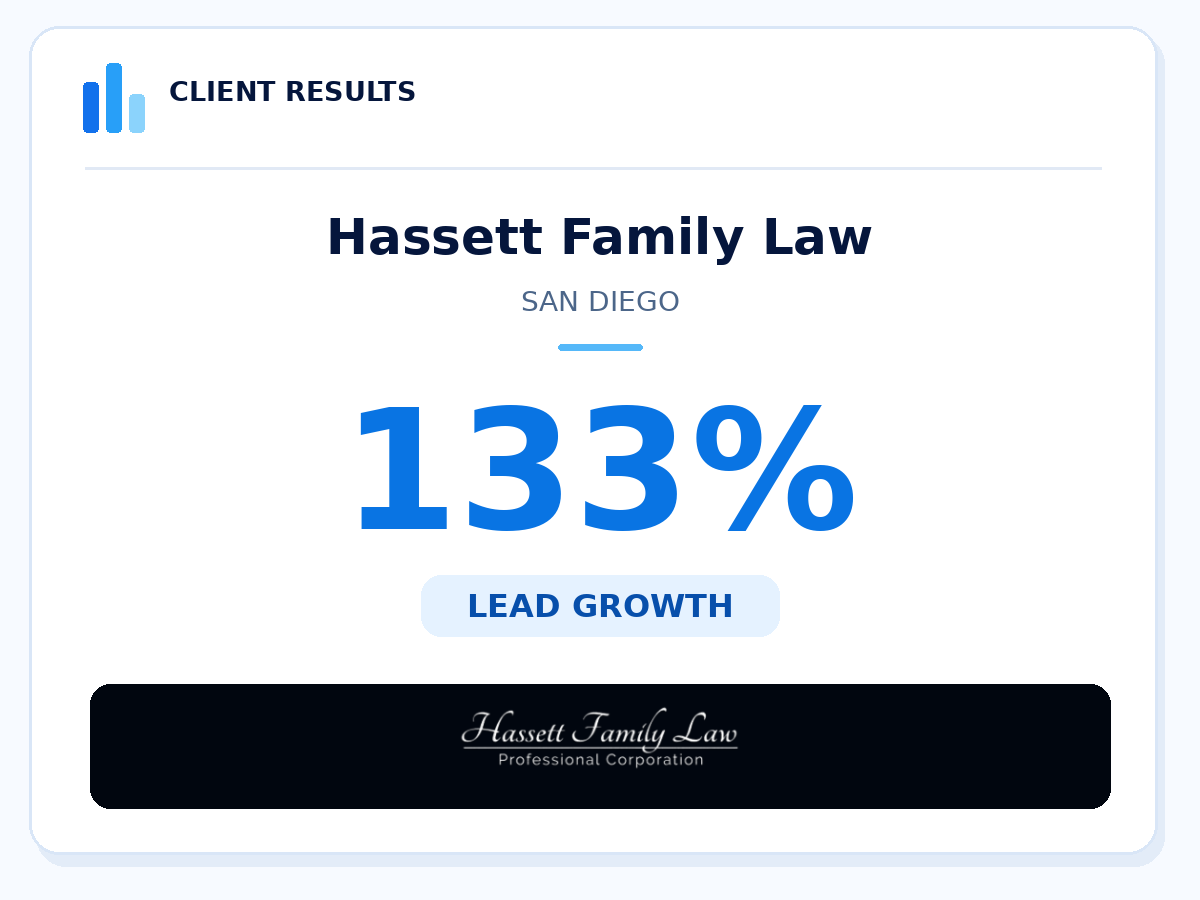
For Hassett Family Law in San Diego, Blue Media reports a 133% increase in leads.
Family law SEO requires an understanding of how prospective clients search for representation and how clearly a firm's website communicates the services available. Practice-area pages, relevant information, and local visibility all contribute to helping potential clients find the right attorney.
The reported increase reflects growth in lead activity for Hassett Family Law in the San Diego legal market.
Litigation, P.C.
Los Angeles law firms compete for attention across an extensive range of legal searches. Established practices may already receive traffic through their websites, leaving opportunities to improve how individual services appear in search and how visitors move toward contacting the firm.
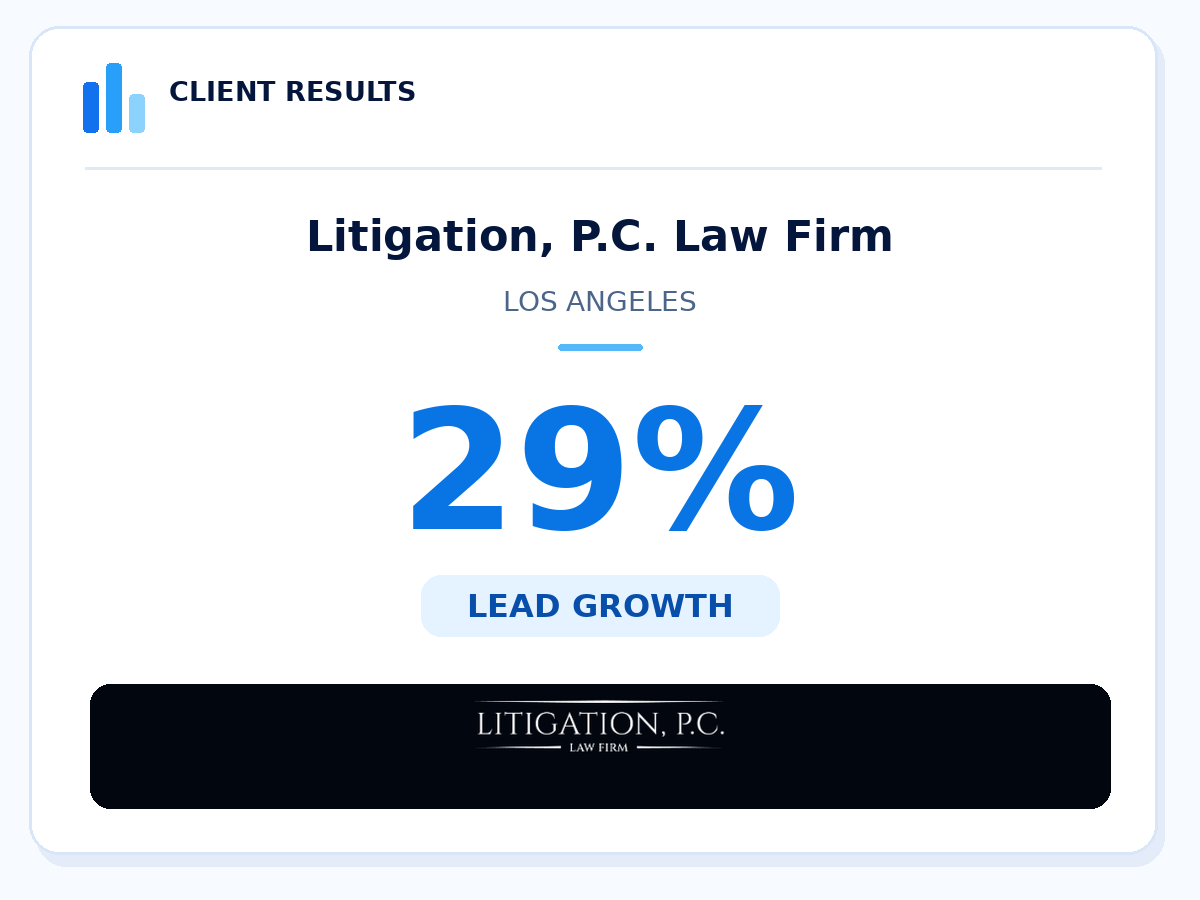
Blue Media's published results for Litigation, P.C. show 29% lead growth.
The result illustrates why SEO performance should be evaluated in relation to a firm's starting point. An established website with existing search visibility presents different opportunities from a newer practice that has yet to build substantial organic traffic.
An increase in inquiries is worth examining alongside search performance, practice-area relevance, and the firm's ability to convert prospective clients into consultations.
La Liga Defensora
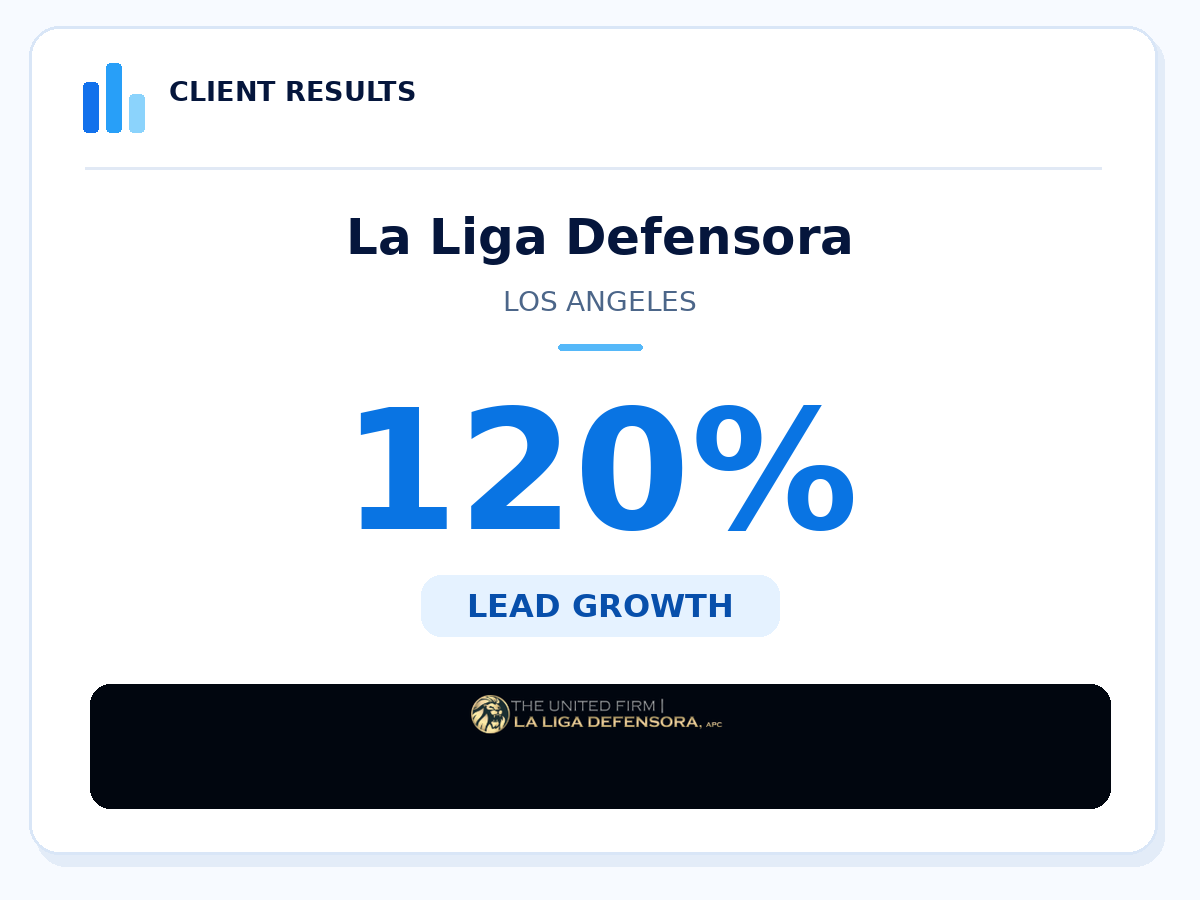
La Liga Defensora operates in the competitive Los Angeles legal market. Blue Media's published results show improvements across multiple measurements of its online performance.
The increase in ranking keywords indicates that the website became visible for a broader range of searches. That growth was accompanied by higher website traffic and reported increases in lead and conversion activity.
For a law firm, expanding search visibility creates opportunities to reach people who may not already know the firm's name. The value of that reach depends on whether those searches relate to services the firm handles and encourage relevant inquiries.
Lead-growth and conversion-growth figures are shown separately because identical measurement definitions have not been established.
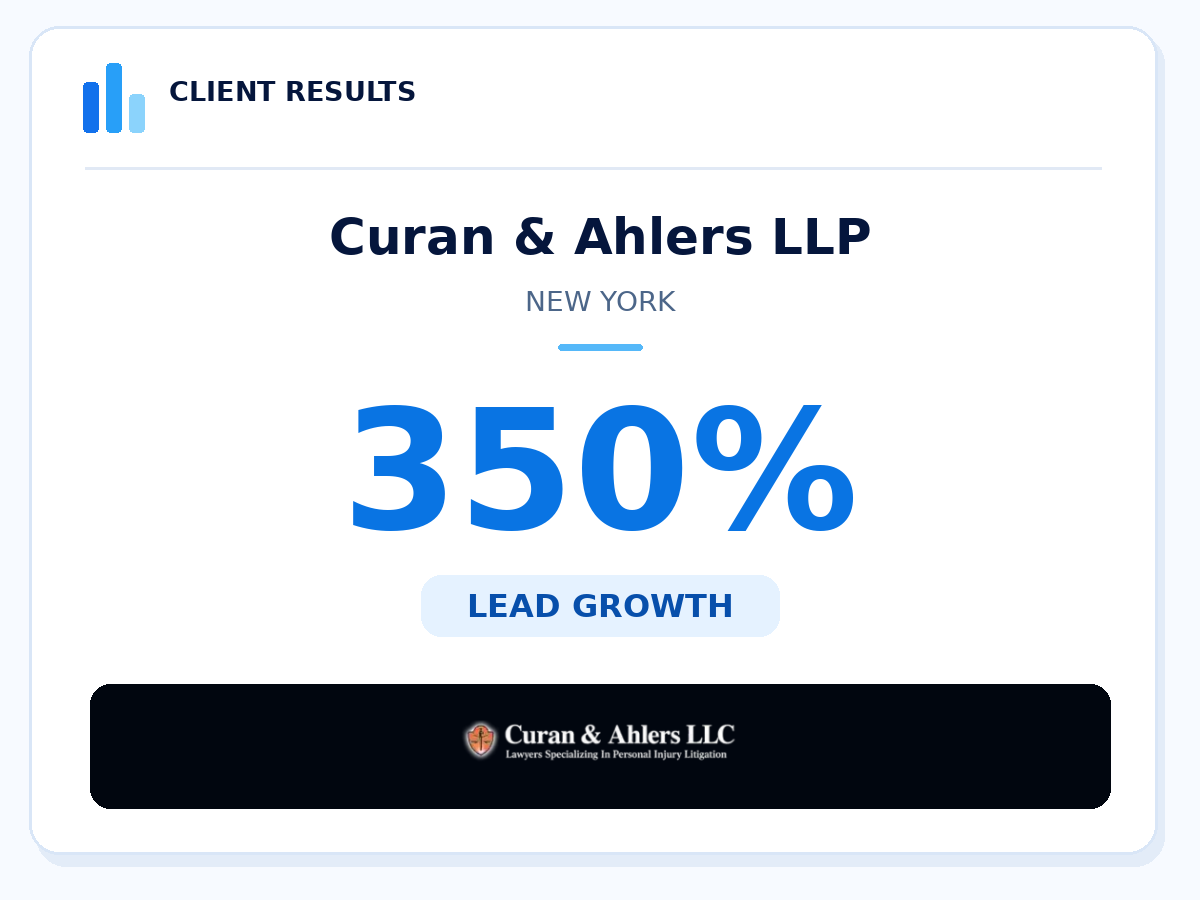
Curan & Ahlers LLP
Curan & Ahlers LLP is a personal injury law firm based in White Plains, New York. Blue Media's published results show substantial growth in its online search presence.
The expansion from 100 to 1,900 ranking keywords is particularly notable. It indicates that the website appeared for a considerably broader range of tracked searches than it had previously.
Personal injury clients may search using the circumstances of an accident, an injury type, or a specific legal service. Visibility across relevant searches gives a firm more opportunities to reach people seeking representation.
The reported increases in traffic and leads provide further evidence of growth in the website's audience and inquiry activity.
The 350% lead-growth and 189% conversion-growth figures are distinct published measurements.
Figures are based on published client results. Reporting periods and lead definitions may differ by client.
Search Visibility Matters. So Does What Happens Next.
A website can rank for more keywords without receiving more qualified inquiries. Traffic, leads, consultations, and signed clients are different measurements. A useful SEO campaign examines how those measurements develop and where the website may be losing prospective clients along the way.
Website Traffic Growth: What an SEO Campaign Can Accomplish
Lead generation is a major objective for law firm marketing, but search visibility and organic website traffic are also important parts of understanding how an SEO campaign develops.
Some websites begin with almost no presence in organic search. Others already attract visitors but have limited visibility for important services or struggle to expand beyond their existing audience.
The following three examples come from Blue Media's broader SEO portfolio. Their clients are not identified as the named law firms featured above.
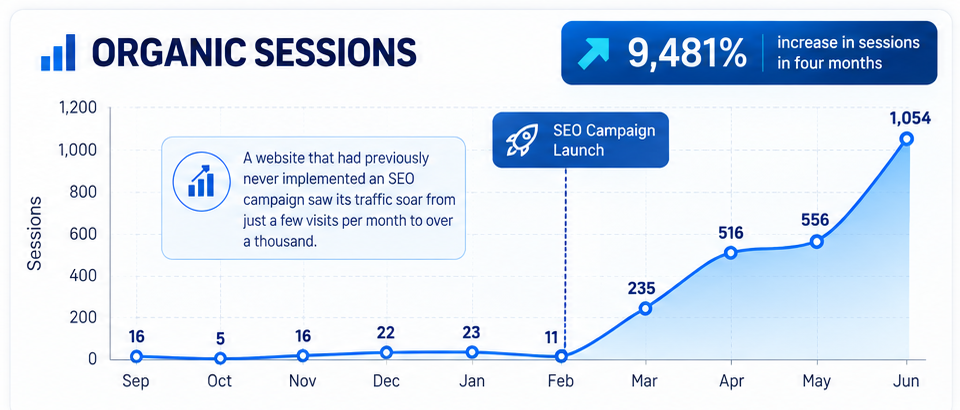
From 11 to More Than 1,000 Monthly Sessions
The first example involves a website that was receiving very little search traffic before its SEO campaign began. In February, the website recorded just 11 sessions. By March, that figure had reached 235.
Traffic continued growing throughout the following months, reaching 516 sessions in April, 556 in May, and 1,054 in June.
The starting position is an important part of this result. A website receiving only a handful of visits has substantial room to improve its presence in search results.
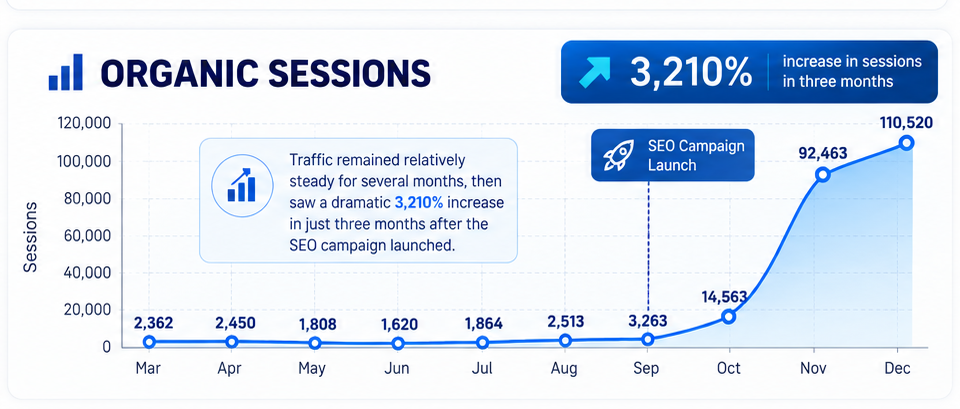
An Established Website Reaches 110,520 Monthly Sessions
This example begins with a website already receiving regular traffic. From March through August, monthly sessions remained relatively consistent, fluctuating between approximately 1,600 and 2,500 visits.
The chart marks the SEO campaign launch in September. Traffic then increased sharply, reaching 14,563 sessions in October and 92,463 in November before climbing to 110,520 in December.
This pattern illustrates how traffic growth can develop unevenly. A website may show limited movement during one part of a campaign, followed by considerable changes in later reporting periods.
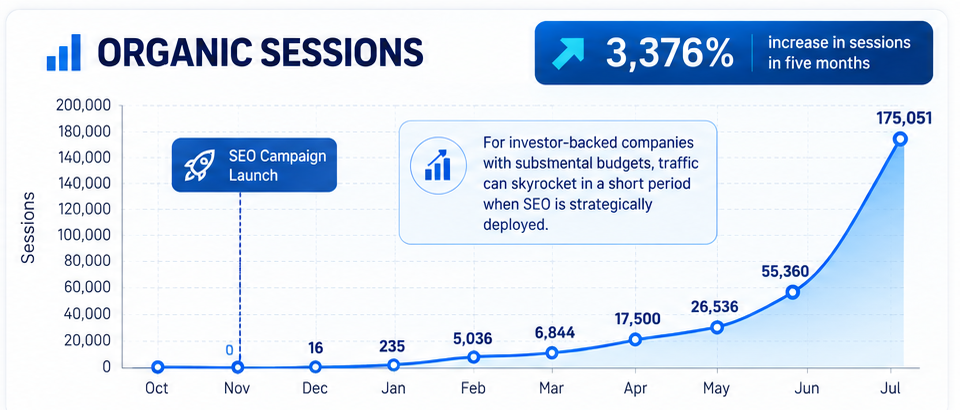
Organic Sessions Climb to 175,051
Our third example shows the level of traffic growth recorded in a larger-scale SEO campaign. The published chart describes an investor-backed company with substantial marketing resources.
During that period, the website recorded 17,500 sessions in April, 26,536 in May, and 55,360 in June before reaching its July total.
The scale of this example deserves context. A company with substantial resources may have the ability to support extensive content development, technical improvements, and a broader marketing strategy.
What These SEO Results Mean for Law Firms
The case studies above show improvements in lead activity, ranking coverage, and website traffic across different campaigns. The figures also highlight several considerations that matter when evaluating your own firm's marketing.
Starting Visibility Changes the Opportunity
A website receiving very little organic traffic may need foundational work before it can consistently reach prospective clients through search.
An established firm may already have useful service pages but need improvements to content quality, technical accessibility, or search coverage.
Greater Traffic Needs the Right Audience
More organic visitors create opportunities for new inquiries, but traffic alone doesn't establish whether a campaign is reaching people who need your services.
Keyword relevance, practice-area priorities, geographic targeting, and the website's consultation experience all deserve attention.
Lead Growth Requires Clear Measurement
Tracked calls, website forms, qualified inquiries, consultations, and signed matters are different stages of the client acquisition process.
Reporting should explain which measurements are being used and how they relate to your firm's actual business objectives.
How We Approach SEO for Law Firms
The results above represent different clients, starting conditions, and reporting periods. At Blue Media Marketing Law, we begin with the individual firm's website and the legal services it wants to promote.
Our approach combines research, technical SEO, content development, local search optimization, and ongoing performance analysis.
Identify the Legal Searches Worth Pursuing
A keyword with substantial search volume isn't necessarily the most valuable opportunity for your firm.
We examine how prospective clients search for particular legal services, which competitors appear for those searches, and where existing pages have opportunities to improve.
Improve the Pages That Matter
Existing practice-area pages often provide a useful starting point for SEO improvements.
That may involve revising important service pages, resolving indexing problems, improving navigation, or creating content around services that aren't adequately represented.
Strengthen Local Search Visibility
Many legal searches have a clear geographic component. People looking for attorneys often evaluate firms serving a specific city or region.
We examine business profile information, geographic targeting, relevant citations, and location-specific content based on the firm's real offices and service markets.
Measure and Refine the Campaign
Rankings and traffic data show how a website's organic presence is changing. Inquiry tracking offers another view of visitor activity.
Ongoing optimization and reporting help identify where progress is occurring and which pages or services require further attention.
What These Case Studies Mean for Your Law Firm
The results from our legal clients demonstrate reported improvements in lead activity, search rankings, and website traffic across several different markets.
They also illustrate why an SEO strategy needs to reflect the individual practice.
A law firm with a well-established website may already have valuable pages that aren't performing as well as they could. Another practice may need a stronger foundation of service content, technical SEO, and accurate local search information before it can compete for its preferred searches.
There is no reliable way to determine the right level of investment from another firm's percentage increase alone. The starting website, competitive landscape, legal services, available budget, and existing intake process all influence where an SEO campaign should begin.
Blue Media Marketing Law works with law firms to evaluate those factors and identify the opportunities that make sense for their practice.
See What Your Law Firm's SEO Could Improve
Your website may already be attracting prospective clients, but there may be important searches and practice areas where competing firms are receiving greater visibility.
Our team can review your current search performance, examine your website's condition, and discuss which improvements deserve attention.
Whether your firm needs stronger practice-area pages, better local visibility, technical SEO corrections, or a more structured content strategy, the right place to begin is with a clear understanding of what's happening on your website today.
About These Results
The law firm lead-growth figures and SEO performance measurements presented on this page are based on results published by Blue Media. The organic session graphs represent separate campaigns from the broader agency portfolio and are not identified as results for the named law firms.
Measurement periods, starting traffic levels, competitive conditions, and campaign scopes vary. Reported leads and conversions do not necessarily represent signed cases or collected revenue. Past performance does not guarantee similar results for another business.
For information about our services, visit Law Firm SEO , Technical SEO for Law Firms , and Law Firm Content Marketing .