Immigration law is one of the fastest-evolving and most competitive legal fields in the country. With shifting regulations, a diverse client base, and unique high-stakes challenges, immigration attorneys must do more than just provide expert legal advice, they need to be discoverable at the very moment a person decides to seek help. In the digital-first era, being visible when someone searches “immigration lawyer” is the difference between growth and missed opportunities. If your immigration law firm wants to secure a steady pipeline of high-value clients and establish authority within your community, investment in SEO is critical.
Blue Media Marketing Law understands the specific pressures and opportunities facing immigration attorneys. With expert marketers in the legal space, our team crafts personalized SEO and digital strategies for immigration law firms of all sizes. We not only help your website show up for high-intent searches, but we also help position your firm as the trusted answer for every visa, citizenship, or green card question that prospective clients are seeking.
Our approach is rooted in understanding your practice areas, local service markets, and client demographics. We blend deep legal knowledge with technical SEO skills, multilingual strategies, local visibility tactics, and transparent reporting. The outcome? More client leads, higher consultation rates, and an online reputation that stands the test of time.
What Our Immigration Law SEO Services Include
We separate searches for legal representation from questions people ask while researching an immigration issue. Both can inform the campaign, but they require different content.
Research also examines geographic opportunities and competing firms. Your keyword-to-page plan identifies which searches belong on existing service pages, which warrant a separate destination, and which are better addressed through an article. This gives the writing and optimization work a defined purpose before production begins.
We review how your pages explain the services offered, introduce the attorneys responsible, and direct visitors toward a consultation. Improvements can include titles, headings, internal links, service descriptions, and contact options.
The deliverable is a set of prioritized page changes. Where a distinct service lacks adequate coverage, we evaluate a dedicated page. Closely related searches may be served by improving an established page rather than commissioning another URL.
For office-focused campaigns, we review Google Business Profile information, relevant business listings, reviews, and location content.
Corrections need to reflect the firm’s actual name, address, services, and operating arrangements.
The work identifies profile updates, listing discrepancies, and website improvements. Review support also requires a suitable request process and carefully approved responses. Our local SEO services for law firms address these parts of the campaign.
Topic planning starts with your services and the questions your intake team hears. We develop content that helps prospective clients understand the firm’s assistance and evaluate whether to contact you.
The content plan identifies the service pages, articles, and updates included in the engagement. Your designated attorneys review legal substance and approve publication. Our law firm content marketing services support the research and writing, with responsibilities established for future revisions.
Technical assessments examine indexing, site structure, internal links, mobile performance, and other implementation issues. Multilingual configurations also need attention when language versions are part of the website.
You receive identified technical priorities, with implementation responsibilities defined in the scope. Some fixes can be made within the existing platform; others require your developer or a separately scoped project. Completed work should be documented and checked.
Our SEO offering includes relevant link development. For immigration practices, opportunities can involve appropriate legal directories, professional organizations, and meaningful contributions connected to the firm’s expertise.
The campaign identifies suitable opportunities and the outreach activity being undertaken. Your attorneys’ experience and existing professional relationships help inform that work. Third-party publishers control whether a contribution or mention is accepted, so placements cannot be guaranteed.
Blue Media’s published onboarding process includes biweekly calls and weekly updates. These provide regular opportunities to review work, resolve approvals, and discuss priorities.
Campaign reviews bring together completed changes, relevant search performance, and available inquiry information. Your intake feedback helps us assess whether the campaign is attracting suitable matters. The next work plan should follow those findings rather than a fixed publishing quota.

We examine the condition of your website, the visibility of its existing pages, your target geographic markets, and the practice areas you want to develop.
Google Search Console, available analytics, keyword rankings, and a technical review help establish that starting point. We also look at whether conversion tracking is functioning well enough to evaluate inquiries attributed to organic search.
A firm with existing search visibility may have valuable opportunities hidden in pages that are underperforming. For another firm, basic technical corrections or missing practice-area content may be the immediate concern.
Your existing inquiries provide a useful starting point. Look at language requests, the communities your firm serves, and the services those prospective clients need.
Demographic information can inform the assessment, but staffing and consultation arrangements must also be considered. A language initiative needs someone who can respond appropriately after a visitor calls or submits a form.
These findings help establish a manageable starting scope instead of translating every page at once.
Research should examine how people search in the selected language. Legal terminology, everyday phrasing, and the way a person describes a problem may differ from a direct English translation.
The production plan identifies who writes or translates the content, who checks its language quality, and which attorney approves the legal information. Those responsibilities need to be settled before material is published.
Service descriptions should remain accurate while giving the reader a clear explanation of the firm’s assistance.
Separate language pages need appropriate navigation, internal links, and technical configuration. Google recommends distinct URLs for different language versions and hreflang annotations to identify corresponding pages.
The implementation review should also check forms, contact details, and links to related services. Each selected journey needs to function as a coherent part of the website.
Forms, booking instructions, and follow-up should support the language being promoted. Establish who handles those inquiries and how the source is recorded.
Illustrative example: A firm with Spanish-speaking intake staff could assess Spanish versions of its priority family-based immigration pages, relevant attorney information, and consultation instructions. Additional services would follow evidence of demand and sufficient review capacity. This is a proposed approach, not a client result.
Where tracking permits, reviews can examine performance by language and landing page. Our multilingual SEO guide for law firms explains the wider planning considerations.
The services your attorneys provide determine the website’s structure. A practice serving employers needs content that addresses business concerns. A firm focused on family-based matters needs to explain its assistance to a different audience.
We use your service mix to plan representation pages, supporting resources, and internal links. Your attorneys confirm the work offered and the boundaries of each description.
Practice focus | Campaign approach |
Family-Based Immigration | Connect representation pages with resources relevant to the firm’s actual family-based services and client questions. |
Employment-Based Immigration | Distinguish employer concerns from individual-client needs, with appropriate messaging and contact paths. |
Citizenship and Naturalization | Separate information about engaging the firm from educational resources covering relevant processes. |
Removal Defense | Review service clarity, geographic relevance, and contact options for people seeking prompt assistance. |
Humanitarian Matters | Develop sensitive, attorney-reviewed information that accurately represents the firm’s services. |
The first decision is whether an existing page can do the job. A broad immigration page may need clearer service explanations, links to deeper material, or more useful attorney information.
A distinct service page becomes appropriate when the firm provides a separate form of representation and can explain it substantively. It should help a prospective client understand the service, assess the firm, and arrange the next step.
Supporting articles can explore questions requiring more depth. They should connect readers with relevant service information without repeating the same hiring page in a longer format.
That distinction matters when budgeting. Each addition requires writing, review, implementation, and future updates. We identify the need before recommending another page, then assign it a place in the website.
The resulting architecture should be understandable to a prospective client and practical for your team to maintain as services change.
Today’s immigration clients are more empowered and resourceful than ever. Most people start their search on Google, often before reaching out for a referral or recommendation. They want fast answers to complicated questions such as “how do I get a green card?”, “How can I sponsor a family member?”, or “Can I still apply for asylum?” They expect law firms to offer direct, bilingual, and trustworthy resources that simplify otherwise complex processes and systems. If your firm isn’t visible at these key touchpoints, potential clients will turn to competitors or DIY resources. Digital visibility, especially on mobile, is the foundation of a resilient, modern immigration practice.
Immigration attorney SEO is not just about ranking for generic terms, but rather aligning your expertise and trust signals with the real concerns of the individuals seeking your services. Laws vary by state and case type, so your local presence and community reputation play a critical role in if prospective clients find you during their search for legal guidance. Lawyers with top rankings don’t just get more phone calls, they become the go-to authorities for all things immigration law within their practice areas.
A strong SEO and digital presence delivers more than just traffic, it impacts every stage of the intake cycle:
With over 3 million pending U.S. immigration cases, the demand for lawyers in the immigration law space is growing rapidly. The number of immigration lawyers is increasing year-after-year, creating a more crowded market. In a world where advertising and capturing a user’s fleeting attention is key, modern law firms must adopt a digital strategy in order to remain relevant among aggressive, newer players in the market.
Prospective clients usually begin by typing specific questions about their immigration situation into Google or another search engine. Many seek help for loved ones, making multilingual access to information essential for trust-building and visibility. Clients usually want immigration layers in their city and show this intent through location-specific queries like “immigration lawyer near me”, “best immigration attorney in Boston”, or “help with 601 waiver in California.”
Most expect clear resources, proof of community ties, prompt contact options and positive examples of cases just like their own. A top-performing immigration law firm doesn’t just focus on search rankings, the most effective strategies blend:
SEO Specialists With 20+ Years of SEO Strategy, Implementation & Data Analysis Experience.
Intro Call &
Mutual Fit
Discovery &
Competitor Review
Custom
Proposal
SEO Execution &
Results
Most immigration law firms begin seeking ranking and traffic improvements within three to six months of launching their first SEO campaign. Larger, more competitive markets or brand new websites may take longer, but incremental progress (like more consultations) can often be measured much sooner. The long-term ROI comes from consistent, ongoing work. SEO results compound over time as your authority and content library grow.
SEO builds sustained, organic growth and authority while paid ads (like Google Ads) generate immediate visibility for high-intent searches or urgent cases. Many successful immigration law firms use a mix of both: relying on SEO for cost-effective, high-intent leads and paid ads when they need a boost during critical seasons or to target a very specific or time-sensitive keyword. Long term, SEO usually delivers a greater return with lower ongoing costs.
Immigration law firm SEO budgets depend on location, goals, and how quickly you want to scale. Small to mid-size firms in urban areas may invest $2,500-$5,000 monthly for ongoing campaigns. Firms in extremely competitive areas or with aggressive growth plans may invest $7,500-$10,000 or more. The most important factor is ongoing, consistent investment and regular analysis of bottom-line results. Working with an agency that tracks intake, not just rankings, ensures you see real business growth.
Yes. With strategic national and multilingual targeting, SEO can bring clients from outside your city, state, or even country. Immigration law is uniquely positioned for expansive online reach. Content marketing that targets specific languages, case types, or international communities extends your practice far beyond your immediate neighborhood.
Our exclusive focus on legal marketing, with deep expertise in immigration SEO and digital strategies, means that your campaigns are designed for your specific industry, niches, and goals rather than a one-size-fits-all business template. We balance technical excellence with a strong understanding of your firm’s values, languages, and cultural relevance, always reporting on business outcomes that matter to your business. Blue Media is dedicated to transparency, measurable results, and building long-term client relationships.
Our law firm clients range from solo practitioners/solo law firms to small boutique law firms and large, full-service law firms.
Blue Media Marketing Law delivers a hands-on, personalized approach to immigration SEO. Every engagement starts with a consultative strategy call, a comprehensive audit of your online presence and an in-depth analysis of your top-ranking competitors in both topical and local search.
Our team builds a custom plan based on your goals and needs, focusing on:
But don’t take our word for it. Real clients have achieved real results through partnership with Blue Media. Our approach has taken small, local immigration practices in competitive areas from minimal rankings to top rankings, driving 2x traffic and doubling their consultation volumes.

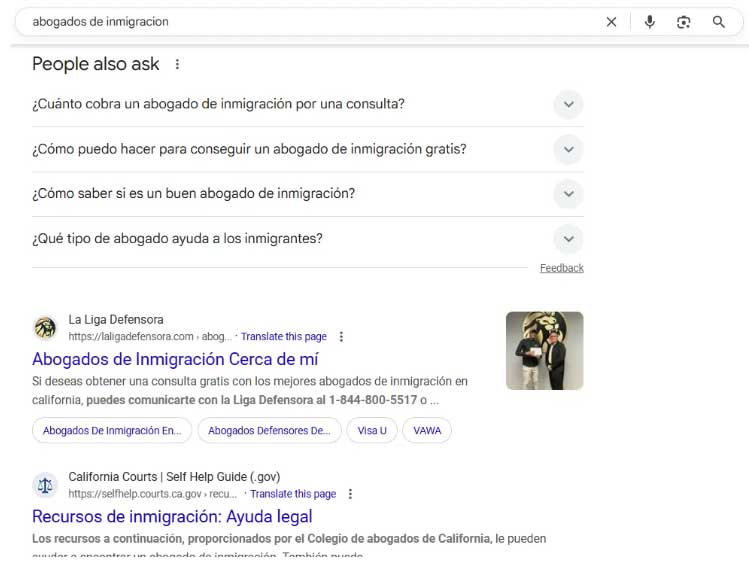
La Liga Defensora based in Los Angeles saw a 250% increase in traffic to their website. The number of keywords they ranked for increased from 2,400 to 6,700 which led to an increase in conversions (clients won) by 120%.
Your attorneys’ knowledge should inform topics and service descriptions from the beginning. The website needs to accurately explain the representation offered and the experience behind it.
Blue Media handles the agreed marketing research and writing. Your designated attorney reviews substantive legal information and approves publication.
Relevant primary sources support the material. Depending on the topic, those sources may include USCIS, the Department of State, or the Executive Office for Immigration Review. Your attorney determines how the information applies to the page and whether further explanation is needed.
The content review process should address:
Changes affecting published service or procedural information.
Outdated references, links, and explanations.
Language versions needing corresponding revisions.
Attorney biographies and experience details requiring updates.
When information changes, review the affected pages together. An update may touch a service page, related articles, and translated versions.
Attorney biographies also deserve attention. Credentials, practice experience, and service responsibilities should be specific and verified by the firm.
Assigning review responsibilities makes the work manageable. Your engagement should identify who flags changes, who prepares revisions, and who approves publication. As the website grows, that process helps keep its content useful and accurate.
North County Immigration is a San Diego immigration law firm featured in Blue Media Marketing Law’s published client results.
The existing case-study figures report:
Ranking count: Increased from 164 to 1,070.
Traffic: Increased by 200%.
Conversions: Increased by 135%.
Each figure measures a different aspect of the reported campaign performance. The ranking count needs to be tied to its reporting source and tracked keyword set. Traffic needs a defined metric and comparison period. Conversion reporting needs to identify the actions counted.
These figures should not be described as retained-client growth without supporting intake records. They also do not establish a specific improvement in Google Maps coverage.