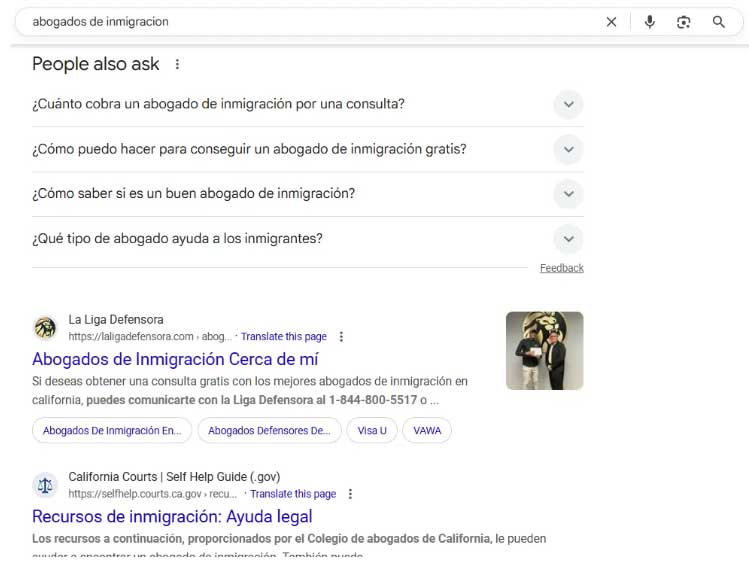

Imagine a managing partner checking Google Maps from the office and finding the firm prominently displayed. Later, a prospective client across town reports seeing competing attorneys instead.
Those searches need closer examination. Neither establishes how visible the firm is throughout its intended market.
The commercial question is whether people seeking the matters you handle can find you where they search. Law firm local SEO should begin with that question, followed by consistent measurements and a plan for the gaps worth addressing.
- Your Office Address Is Only Part of the Equation
- Build a Baseline Around the Clients You Want
- Treat Geographic Patterns as Investigation Triggers
- Prioritize the Gaps That Matter to Your Practice
- Evaluate the Distant Market Before Funding Expansion
- Connect Local Visibility With Blue Media’s Campaign Execution
- Questions Partners Should Ask About Geographic Reach
- Find Out Where Your Firm Is Visible Before Expanding the Budget
Your Office Address Is Only Part of the Equation
Google identifies relevance, distance, and prominence as the main considerations behind local results. Relevance concerns how well a profile matches the search. Distance concerns the business’s proximity to the searcher. Prominence concerns how well-known the business is, with links and reviews among the information Google considers.
That means distance deserves attention, but it should not become the explanation for every weak result.
Start by comparing the searches themselves. Was one person searching your firm’s name while another searched “divorce attorney”? Did one query name a city while the other relied on the searcher’s location?
A branded search and a search for legal representation answer different questions. Keep them separate in your assessment.
Google does not publish a fixed mileage boundary or percentage weighting for these factors. A ranking near the office therefore gives you a starting observation, not proof of citywide coverage.
Before changing the profile or discussing an office move, establish what you are actually measuring.
Build a Baseline Around the Clients You Want
Ask your marketing team for geographic measurements using specific queries and documented search points. The report should identify the business profile being tracked and the local search surface being measured.
A Maps measurement should not quietly replace a Local Finder measurement between reports. If the tool or methodology changes, disclose the change before comparing results.
Document:
- The exact query and profile.
- Search-point coordinates, grid dimensions, and spacing.
- Measurement dates and the local surface tracked.
- The tool’s ranking cutoff.
- Relevant profile, website, or campaign changes.
Choose queries that reflect actual services. A family law firm could evaluate “child custody attorney” separately from “divorce attorney.” An immigration practice could investigate “immigration lawyer” alongside a more specific service query that fits its caseload.
These are query examples, not claims about demand. Validate them against research and intake priorities.
For distinct offices, establish separate baselines. Keep the settings consistent across repeat measurements and record any changes in the geographic area covered.
Treat “not found” carefully. If a tool searches only a limited number of positions, the report establishes that the firm was not detected within that cutoff. It does not establish an exact lower rank.
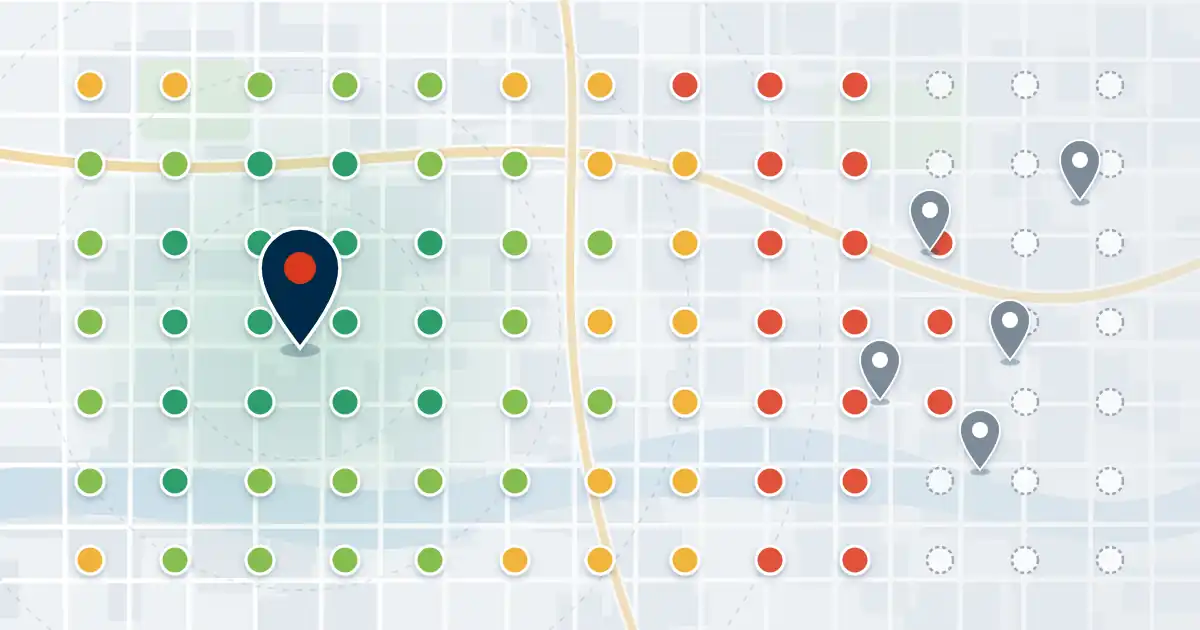
Finally, ask what the visualization demonstrates. A grid samples selected searches at selected points; it does not count prospective clients or show every search conducted there. Require labels and measurement settings alongside the colors.
Treat Geographic Patterns as Investigation Triggers
In local SEO for lawyers, an uneven report helps organize an audit. It cannot establish the cause of each weak point on its own.
- Strong near the office, weaker farther away: Compare distance and competing offices at the weaker points. Check whether the query accurately represents your services before treating the entire outer area as an expansion opportunity.
- Weak even near the office: Review profile accuracy, verification, categories, and service information. Inspect the linked website destination and investigate whether it clearly supports the service being measured.
- Strong for one practice area, weak for another: Compare profile relevance, website coverage, and competing firms for each query. Do not assume that success for divorce representation establishes coverage for custody matters.
- Strong in one direction, weak in another: Inspect search coordinates and competitor locations. Review whether the pattern persists before attributing it to a neighborhood, geographic barrier, or website issue.
- Abrupt changes between scans: Confirm comparable settings first. Then review profile edits, website changes, and the competitors present in the new results.
For each pattern, request three things: the observation, the proposed explanation, and the evidence needed to test it.
A law firm local SEO company should make those distinctions clear. “We need more reviews” is a proposed action. It is not a complete explanation of a geographic report.
Prioritize the Gaps That Matter to Your Practice
Decide which locations and services deserve investment before approving optimization work. Consider the matters you accept, your service coverage, intake capacity, and available acquisition data.
A weak point outside your practical market may deserve less attention than poor visibility for a desired service near the office. Make that prioritization explicit.
Our recommended scope for local SEO services for law firms organizes the work into four areas:
- Profile accuracy and relevance: Review the business details, appropriate categories, services, and linked destination.
- Website coverage: Improve relevant service pages and identify justified content gaps.
- Credible local presence: Correct inaccurate listings and plan legitimate legal or community outreach.
- Conversion readiness: Check contact options, mobile usability, tracking, and intake handling.
Google says complete, accurate profile information helps it understand a business. Its guidelines also require real-world business naming and appropriate categories. Adding keywords to a name without a legitimate naming basis is not an acceptable shortcut.
For reviews, create a consistent request process without incentives or selectively soliciting positive feedback. Google prohibits both practices. Protect confidentiality in requests and responses.
Ask for tangible outputs: an audit, prioritized page recommendations, listing corrections, an outreach plan, and tracking checks. Each should connect to an identified need.
Evaluate the Distant Market Before Funding Expansion
If a commercially attractive area remains difficult to reach, evaluate your options separately.
Improve Organic Website Coverage
Improve organic website coverage when research identifies a distinct need that your site does not adequately address. Review existing pages before commissioning city-specific additions.
Test Paid Acquisition
Test paid acquisition when you can define the services, target geography, budget, and intake process. Google Ads management for law firms should be assessed using qualified inquiries and acquisition economics. Google Ads and Local Services Ads are paid channels; their results should be reported separately from unpaid Maps positions.
Assess Another Office
Assess another office when there is a genuine business case for it. Include staffing, occupancy costs, client access, and operating requirements. Google excludes virtual mailing offices where the business does not operate, and sets conditions for eligible coworking offices.
Do not approve overhead based on a ranking screenshot. Request evidence of market fit and a workable acquisition plan first.
Connect Local Visibility With Blue Media’s Campaign Execution
Blue Media Marketing Law’s published local offering includes profile optimization, localized content, citation management, review support, technical optimization, and conversion tracking.
Begin with an assessment, agree on priorities, implement the work, and review the results against the baseline. Geographic tracking is a recommended measurement method to discuss when defining the engagement scope.
Practice-specific decisions belong in that process. Family law SEO can reflect the matters a firm wants, while immigration attorney SEO should account for actual services and supported language journeys.
Coordinate those decisions with the broader law firm SEO strategy. Request reports that show completed work, comparable visibility measurements, and qualified inquiries.
When evaluating a law firm local SEO company, ask how its reporting separates those measures. Better visibility, more inquiries, and retained matters are distinct outcomes that require distinct evidence.
Questions Partners Should Ask About Geographic Reach
Why can a prospect across town see competitors that my office search does not show?
Google considers distance alongside relevance and prominence. Compare the exact query, search location, and result surface before drawing conclusions. A difference warrants investigation, but it does not establish that your profile is broken. Use repeatable geographic measurements to assess whether the pattern persists.
Does private browsing provide a dependable picture of our firm’s local rankings?
Private browsing alone is insufficient. Chrome’s Incognito mode does not hide your activity from the websites you visit or your internet provider. Document search location, query, and result surface separately; a private window does not establish a comparable geographic measurement.
Can adding nearby cities to our profile make us visible throughout those cities?
Service-area information describes where an eligible business provides services. Google limits that feature to service-area and hybrid businesses under its definitions. It is not a promise of ranking coverage. Confirm your business model and keep the information accurate before changing those settings.
How should we assess competitors that appear farther from their offices than we do?
Compare the same queries, search points, and result surface. Then examine services, profile information, website coverage, and credible authority signals. A wider apparent reach does not reveal its cause. Request a comparative audit rather than copying one visible feature, such as a category or review count.
Which geographic reporting measures help us judge progress beyond an average rank?
Request point-by-point changes for priority queries and locations. If the selected tool reports top-three coverage or visibility scores, require definitions and consistent settings. Keep cutoff results visible. Treat these as sampled visibility measures, then assess qualified inquiries separately rather than assigning revenue to individual grid points.
Will publishing a page for every nearby suburb improve our Maps coverage?
Do not use page count as a coverage guarantee. Each geographic page needs a distinct purpose and useful information. Google’s doorway policy addresses substantially similar pages created for related searches. Request a selective content plan and evaluate website performance separately from geographic Maps measurements.
What should we check before opening another office to reach a new market?
Assess actual demand, desired matters, staffing, operating costs, client access, and Google eligibility. Compare those commitments with other acquisition options. Marketing research can inform the decision, but a new office requires an operational business case. An address acquired solely for a listing is not a substitute.
How can we tell whether better Maps visibility is producing the cases we want?
Connect reporting to intake records. Google’s profile “calls” metric counts call-button clicks, not confirmed conversations or retained matters. Profile performance can also include organic and advertising activity. Use tracking and intake outcomes to identify qualified consultations and signed clients, while documenting attribution limitations.
Find Out Where Your Firm Is Visible Before Expanding the Budget
Your office search is one observation. Before committing to more content, advertising, or another location, establish a comparable baseline across the services and areas that matter to your practice.
Then prioritize the gaps supported by evidence and a realistic path to qualified consultations.
Discuss local SEO services for law firms with Blue Media Marketing Law and request an assessment of your current campaign. Bring your profile details, priority services, and available intake data so the discussion starts with your business objectives.