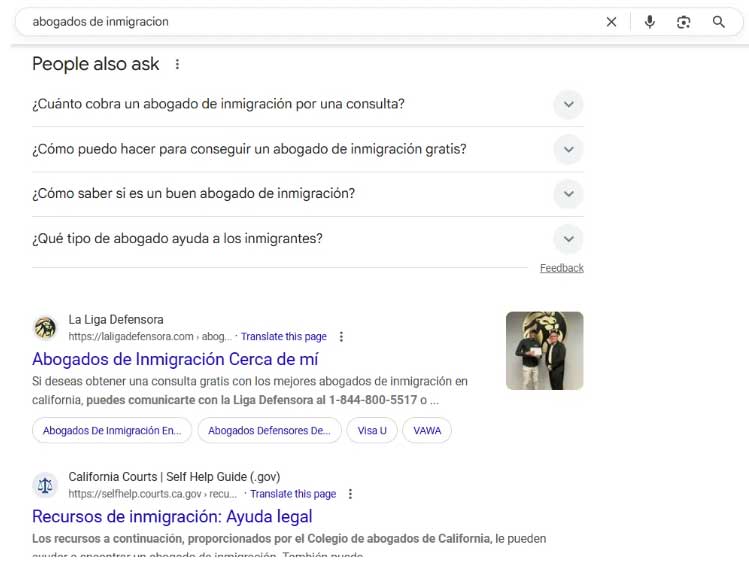


Law firms looking to attract a larger number of clients will want to make sure they aren’t overlooking non-English speaking individuals searching for legal assistance. The United States is home to millions of people who utilize a language other than English as their primary form of communication. They’re just as likely to be among the many searching for the help of trusted attorneys.
For non-English speaking individuals, pinpointing attorneys who can communicate clearly in their preferred language can be extremely difficult. For law firms, this provides a big opportunity as well as increased responsibility to clients. If your firm’s website exclusively serves English-speaking users, you’ll find that you unintentionally exclude a big portion of your potential client base. This is where multi-language SEO for lawyers can bridge that important gap. It’s a tool that helps your firm appear at the top of search results for lawyers, attorneys, and law firms when those searches are happening across multilingual audiences.
Strategy Guide- Breaking the Language Barrier: Technical and Cultural SEO Strategies for Attorneys
To be successful, bilingual legal marketing strategies must be culturally informed and consistently intentional. It’s also important that they are technically sound approaches to building a multilingual digital presence online. Here, we’ll look at what it takes to ensure your firm’s bilingual legal marketing is compliant, accurate, and effective in both the short and long term.
Hreflang Tags and Site Architecture- Subfolders vs Subdomains
A strong technical foundation is key to a multilingual website for your firm that functions well. This is what’s going to ultimately determine whether search engines can correctly understand, index, and deliver your content seamlessly to the intended user groups. Hreflang tags and overall site architecture must be taken into account when you’re putting together vital components of multi-language SEO for lawyers. If these aren’t firmly in place, Google can potentially show the incorrect language version to users online. There’s also a chance that your translated pages simply won’t show up.
There are Many Reasons Why Hreflang Tags Matter
The difference is always in the details when it comes to multi-language SEO for lawyers. A significant detail to never overlook is the incorporation of hreflang tags. These directly tell search engines what language and region your pages are intended for. Hreflang tags are also important in preventing duplicate content issues across your site. Hreflang tags can also help:
- Reduce bounce rates that occur as a result of mismatched content
- Ensure the correct language version is making its way to the correct audience
- Strengthen your overall bilingual legal marketing strategy
Improve your rankings for Spanish SEO for law firms specifically

Verify You Have the Right Site Structure in Place for Your Firm’s Goals
Understanding the differences between subfolders and subdomains for your firm’s multilingual content online is important as well. While both options are viable, their functions vary, and each has unique implications for SEO strategies. Firms that lean into subfolders will find that they can easily keep all language versions under the same domain. Firms that use this strategy typically prefer subfolders (example for Spanish content: /es/) because:
- They’re easier to manage and maintain over time
- Authoritative content is all consolidated under a single domain
- Analytics are similarly centralized
- Google can index and crawl subfolders rather efficiently
If your firm wants a scalable and streamlined approach to multi-language SEO, subfolders are typically a good way to go. Alternatively, subdomains (example: es.yourfirm.com) are put in place by firms looking to separate language versions into distinct sections online. This type of structure is extremely useful when a firm has:
- A large volume of content across a variety of languages to showcase
- A variety of professional teams managing different languages at once
- Separate CMS or hosting setups in place
While subdomains can be great for keeping language content organized, it’s important to note that they typically do require more maintenance. They also come with a possibility of diluting domain authority over time.
Translation vs. Transcreation — Why AI Translation Is a Liability for Law Firms
When it comes to multi-language SEO for law firms, it can be easy for attorneys to assume that it’s enough to simply run website content through an AI tool for translation purposes. In reality, this can lead to disastrous results for law firms and their clients alike. Legal content is heavily regulated and nuanced. Running high-stakes content through an AI translator can lead to mistranslated phrases that entirely change the meaning of legal rights. These tools can also potentially misrepresent legal services, ultimately creating large ethical issues. This is why transcreation, not basic AI translation, is a must for bilingual legal marketing initiatives.

Avoid the Risks of AI Translation From the Start
While AI translation tools are certainly improving over time, they’re not yet at a point where law firms can exclusively depend on them for clear, accurate, and legally specific authority. Many of these platforms continue to struggle with:
- Regional dialects
- Cultural context
- Legal terminology
- Tone
- Formality
- Compliance language
- Mandatory disclaimers
Far too often, running your multi-lingual legal content through an AI translation tool will result in content that’s inaccurate, vague, and misleading.
Understanding Transcreation and How it Works Differently
Law firms that use transcreation over generalized AI translation platforms will find that this approach allows for accurate word-for-word translation. Unlike an AI translation tool, transcreation can adapt your multi-lingual content within the parameters of cultural context, meaning, and tone. This ensures your messaging is not only accurate but successfully resonating with your target audience. Transcreation for content across languages can mean:
- Adjusting content to match local norms
- Rewriting legal explanations for points of cultural clarity
- Verifying all disclaimers are legally accurate across languages
- Adjusting tone while preserving authority and intent of the original content
Currently, law firms simply cannot rely solely on automated tools when it comes to ensuring legal content is culturally aligned and precise. Legal content always requires meticulous attention to detail and mistranslated terms by automated platforms can confuse readers while leaving your first at risk. Instead, law firms would be well served to implement best practices that specifically cater to creating high-quality multilingual content. This could include:
- Working with professional legal translators
- Having content consistently reviewed by bilingual legal marketing specialists
- Removing auto-translate plugins from your marketing strategy
- Setting standards for consistent terminology across all language content
- Ensuring forms, CTAS, and disclaimers are fully trans-created
Localized Keyword Research — Cultural Nuances in Search Intent
Many SEO experts would agree that the backbone of the strategy has long been keyword research. While this still applies to multilingual SEO, there are certainly some differences to note. That’s because directly translating English keywords to other languages is rarely effective on its own. People search differently across cultures and languages, making it essential to authentically understand those cultural nuances to ensure keywords rank and also meet legal needs.
Why Direct Translation Fails Time and Again
Different languages allow for many variations on meaning for similar phrases. For example, a search for “car accident lawyer” in English would directly translate to “abogado de accidents de auto” in Spanish. Yes, the translation is direct, but it’s off-base when it comes to terminology many fluent Spanish speakers would use online. It’s far more likely that a Spanish search phrase for “car accident lawyer” would be somewhere along the lines of “abogado de choque.” This is a phrase that more closely reflects cultural norms and interpretations of that same keyword phrase in English. Taking cultural nuances into account with language translation is vital, because it consistently influences search behavior. Speakers of primary languages outside of English may:
- Search for symptoms instead of direct legal terms
- Use conversational phrasing when searching for legal assistance online
- Integrate regional dialect variations into their searches
- Prioritize trust-based terms into keyword phrases
The ability to identify and understand these nuances will help your firm strategize accurately when it comes to integrating terms clients actually use– not just how English phrases directly translate on the page.
How to Conduct Localized Keyword Research for Multiple Languages
Multilingual keyword research takes time. That said, it’s worth your while to invest in this research when you want your firm’s website content to be accurate, clear, and communicate fluently with your bilingual clients. You’ll need to:
- Identify regional dialects
- Analyze search trends that exist in your firm’s geographic marketplace
- Utilize keyword tools that directly support multi-language inquiries
- Review competitor multi-lingual content
Have bilingual staff or community partners review content before posting
Taking these steps ensures your Spanish SEO for law firms, as well as content for all other languages you work with, accurately reflects real-world language patterns. With these keywords in place, you can begin to look at making sure your multi-lingual content is clearly answering the questions your clients are searching for. It’s a good idea to always:
- Avoid overly technical legal jargon across languages
- Make sure content is scannable and concise
- Implement plain-language explanations whenever possible
- Provide plenty of legal examples within the context of specific cultural norms
Ethical Considerations — Ensuring Your Staff Can Actually Handle the Leads
When law firms offer multilingual content online, clients know from the start that they can easily communicate with attorneys in their preferred language. This sets an expectation of trust with your firm that deserves to be met every step of the way. To that end, your firm also needs to be able to follow up with leads in their primary language so you don’t damage the trust you’ve built early on, or create ethical issues along the way. For example, if you provide content online in Spanish, you need to make sure you have follow-up resources in place. This could include:
- Spanish language intake forms that are readily available
- A bilingual receptionist to answer incoming calls
- Accurate interpretation services available during consultations
- Attorneys who can explain legal processes clearly across languages
Having these resources in place is a sure way to put clients at ease, continue to build trust, and avoid any feelings of being misled. Above all, it’s essential that law firms not use multilingual content on their websites exclusively to drive leads. When this content is implemented as a marketing tactic, your firm’s ethical integrity can quickly be put at risk. Steps firms can take to avoid these ethical pitfalls can include:
- Employing certified interpreters
- Ensuring there’s an intake team on-site that’s manned by bilingual staff members
- Requiring cultural sensitivity training for employees
- Removing any promises online that you can’t actually deliver in the languages you’re featuring
Ultimately, user experience has the power to significantly affect rankings. Ethical alignment across your multilingual content will reduce bounce rates among prospective clients looking for help in non-English primary languages. You’ll promote a culture of client satisfaction that’s authentically inclusive and not set up merely as a marketing scheme to draw in new leads.
Becoming the Inclusive Authority in Your Local Market
When your firm makes the choice to build a multilingual digital presence online, it goes far beyond a traditional marketing strategy used by other firms. It’s a clear commitment on the part of your firm to be a trusted resource for your entire community. Investing in multi-lingual SEO for lawyers allows you to strengthen trust across cultural boundaries, expand your legal reach, and really position yourself as an authority in your area. Firms that take time to meet the needs of a multi-cultural community with authentic cultural understanding in place always stand out in a crowd. If you’re willing to invest in high-quality transcreation, build strong technical foundations, and focus on localized keyword research, you’ll have the opportunity to be a multilingual legal resource that’s effective, responsible, and successful.