


It’s common for law firms to struggle with issues around whether to invest in PPC or SEO when it’s time to pick a preferred approach to their digital marketing. Questions around SEO vs PPC for law firms can feel complex because both channels can drive leads successfully, but they also operate very differently. The “fast results vs long-term asset” debate isn’t new for law firms looking at their marketing strategies and wondering how each channel could potentially affect cash flow over time.

That makes looking at the pros and cons of each channel individually extremely important. While some law firms are inevitably drawn to PPC for its ability to generate immediate leads, SEO can generate leads more slowly, but at a lower cost per acquisition compared to paid ads. The process of picking exclusively between an investment in long-term assets or short-term revenue generation will likely come down to a firm’s unique marketplace, practice area, and cash flow considerations.
Comparative Breakdown and The Synergy of Search: Why the Correct Strategic Answer is Always “Both”
It’s important for law firms to understand that the decision on which channel to use doesn’t necessarily have to be an “either or” solution. In fact, some of the most successful law firm digital marketing strategies out there integrate both PPC and SEO into the mix. This combination can enhance a sustainable pipeline while also enjoying immediate leads. In many ways, SEO and PPC aren’t competitors. They’re more realistically complementary marketing channels that have the unique ability to strengthen one another over time. When seamlessly combined, they can successfully capture leads at every stage of intent.
PPC — The Immediate Lead Machine: Pros, Cons, and the Reality of Bidding in Competitive Markets
PPC advertising is a fast and efficient way for law firms to generate leads in a short amount of time. It’s a strategy that works primarily through Google Ads. For example, if someone is online searching for a phrase like “divorce attorney,” related PPC ads will immediately appear at the top of the search result list. This type of prominent placement quickly captures the attention of high-intent users who are likely looking to call an attorney for help immediately. Some additional pros of PPC for law firms include:
- Options to hyper-target by device, time of day, location, or search terms
- Full control over a marketing budget by scaling up or down depending on seasonal trends and a firm’s caseloads
- A predictable lead flow when campaigns are meaningfully optimized
- A strategy that works for urgent practice area searches like personal injury, family law, DUI, and criminal defense
While the pros of this marketing approach are exciting, there are some drawbacks to consider as well. Cons of PPC can include:
- A heightened click fraud risk stemming from bots or competitors in the marketplace
- A high cost per click standard with legal keywords ranking among the most expensive
- The possibility of wasted campaign funds if expert management isn’t in place for ad spend
- A lack of long-term equity as visibility disappears as soon as ad placement isn’t paid out

It’s also essential to look at the necessity of bidding in competitive markets when PPC is a primary or preferred marketing channel for your firm. As the Google Ads keyword planner often showcases, legal PPC has earned a reputation for being extremely competitive. Depending on the market you work in, clicks for searches like “personal injury lawyer” could exceed $300. Even criminal defense and DUI terms have been known to range from $40 to $150 per click. Without an experienced marketing management team in place, you could find yourself draining your budget quickly on nothing more than broad targeting. Alternatively, when PPC is managed strategically and well, it’s a powerful tool for attorney lead generation. To this end, PPC is a good choice for:
- Firms looking to step into new markets
- Firms looking to increase their case load immediately
- Firms with flexible budgets
- Firms that need predictable lead flow
- Law practices with high-value case focus like DUI and criminal defense
As an immediate lead machine, PPC can be counted on to deliver fast results, especially when matched with call tracking, geographic targeting, optimized landing pages and negative keyword lists. That said, it should never be your firm’s exclusive marketing strategy.
SEO — The Compound Interest of Marketing: Building a Moat that Competitors Can’t Easily Buy
For law firms that are looking to build on sustainable growth, SEO is a marketing channel that’s typically extra appealing. Unlike fast-working PPC, SEO is set up to build equity over time. Each piece of content, optimized page, and backlink built into the SEO strategy is purposefully in place to strengthen a website’s authority. It’s also designed meticulously to increase your firm’s visibility in organic search results. There are many pros of SEO for law firms to consider including:
- Broad visibility for websites that successfully capture commercial, informational, and local searches
- Long-term return on investment at a fraction of PPC once rankings have been properly established
- An emphasis on strong brand authority with high rankings signaling credibility for your firm
- Higher trust value among users compared to paid ads
On the flip side, SEO isn’t without its own pitfalls. This is a marketing channel that takes a significant amount of time and expertise to implement. In some competitive areas of legal practice, this could mean anywhere from 6 to 12 months to rank. Additional concerns for some law firms around the exclusive use of SEO include:
- Algorithm changes that can occur when Google updates impact rankings unexpectedly
- The need for adding constant and consistent content to a website
- Expert technical requirements that need to be in place around site speed, UX, and schema
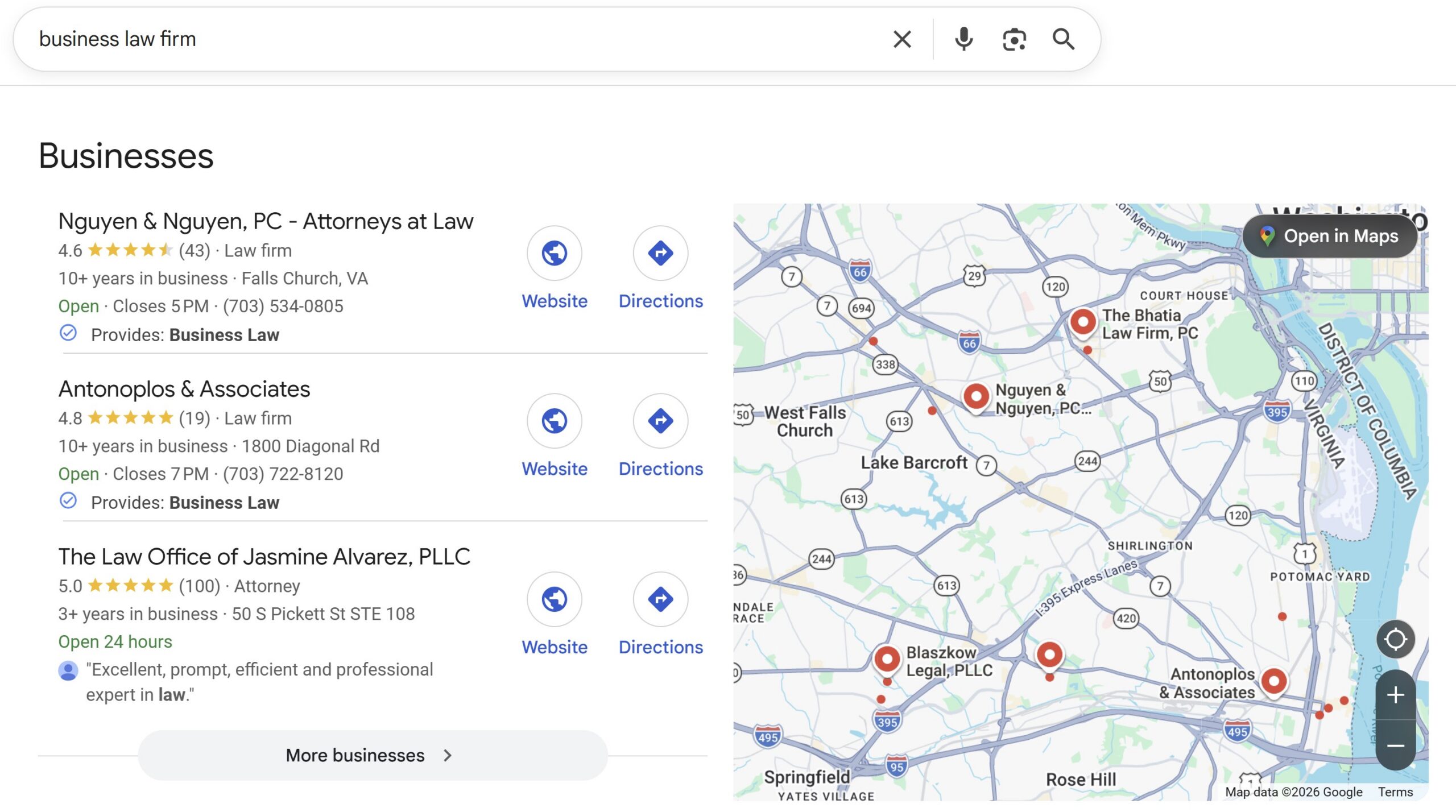
While these concerns are certainly valid, it’s important to remember that where PPC can be outbid by competitors, SEO isn’t able to be out-spent in quite the same way. Once you manage to get your firm to rank first in organic searches and you’re firmly in the Map Pack, your competitors don’t have options to simply pay more to surpass you. A strong SEO strategy will make it necessary for competing firms to invest in the same channels to reach your levels, and this could take months or even years if you’re already well ahead of the game. This is typically described as “compound interest” where the longer you invest in SEO the more powerful your results prove themselves to be. This makes SEO a firm foundation of sustainable law firm digital marketing and it’s typically best for firms with:
- High search volume in place
- Established and stable cash flow
- Reduced PPC dependency
SEO can also be a smart marketing move for firms that are looking to build long-term dominance in their marketplace. It’s also a strategic marketing strategy for firms that are excited to expand their work into neighboring cities or practice areas over time.
How PPC Data Informs SEO Strategy: Using Paid Search to Find “Winning” Keywords
Law firms that choose to run PPC and SEO in tandem will quickly discover there are many advantages. Among them is the data synergy just waiting to be put to work on your firm’s behalf. As PPC provides that exciting real-time keyword performance insight, it can be collected and used to successfully shape your powerful SEO strategy. The data you uncover when using PPC can help strengthen your SEO by revealing negative keywords along the way. This allows you to refine SEO content going forward as a way to efficiently avoid irrelevant search traffic on your website. PPC data also helps SEO by:
- Testing landing page messaging before you commit to integrating it into your long-term SEO content
- Validating content opportunities when PPC keywords convert well, and could be used as more intricate SEO landing pages
- Identifying user intent patterns that are emerging by device type, time of day, and location
- Pinpointing high-converting keywords for SEO strategies based on form submissions and call conversions
PPC also has the ability to boost SEO strategies by finding those “winning” keywords needed to attract high-intent attention. With PPC in place alongside SEO, it’s easy to see how PPC gives immediate feedback on keywords that drive leads, create the most clicks, waste your marketing budget, or produce high-value cases. With this information in place, your SEO team can build content that’s already proven to be successful and eliminate guesswork from the process entirely.
Budget Allocation: How to Split Your Spend Based on Firm Age and Practice Area
When it comes to allocating your marketing budget, not all law firms are created equal. In fact, every law firm should take time to evaluate their budget allocation based on firm age, practice area, and major competitors alike. Because newer firms (0 to 2 years in practice) are often looking to acquire an immediate influx of leads to help stabilize their revenue, leaning more heavily into PPC over SEO is a strategic move. For example, a 70% PPC to 30% SEO split could help deliver fast results, while initiating an SEO strategy that will slowly begin to build long-term authority for a new firm.

Practice Area Considerations Not to Overlook
Longevity in the legal field is always an important factor when deciding how to allocate a marketing budget at your law firm. It’s equally important to account for the specific practice area you work in. When it comes to smart budgeting, it’s important to consider that:
- Family law typically sees high search volume and would benefit from a strong SEO focus
- Personal injury is often linked to high PPC costs, making it a good practice field for SEO investment
- Immigration law often benefits from targeted PPC and meticulous multilingual SEO strategies
- Criminal Defense goes hand-in-hand with urgent searches, requiring an even balance of SEO and PPC
- DUI cases come with high-intent searches that need SEO for authority online, and PPC for immediacy
When you take time to look closely at your specific legal field and your firm’s experience level, it’s easier to allocate your budget around urgency and long-term goals in tandem.