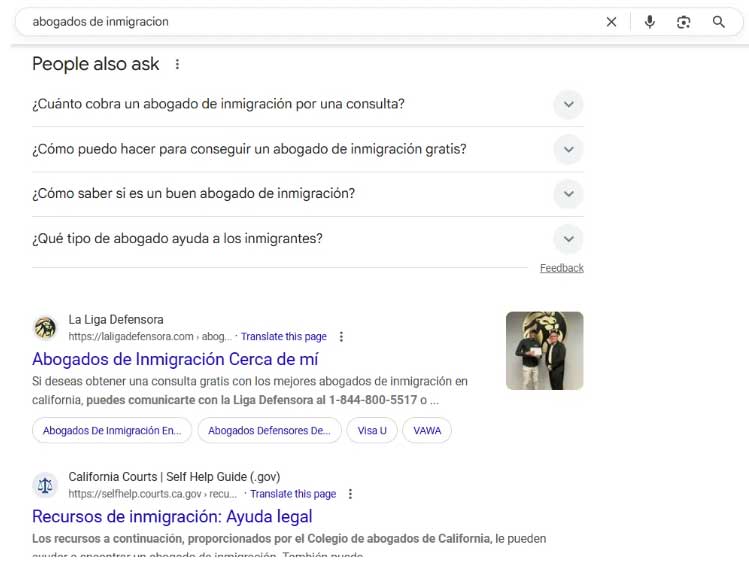

The Illusion of High Traffic: Why Your Law Firm Is Bleeding Potential Retainers
Your law firm just received the monthly marketing report. The numbers look incredible on paper. Your website traffic is up thirty percent, your organic rankings are climbing, and your Google Ads campaigns are driving thousands of clicks. The marketing agency is patting themselves on the back. Yet, when you look at your actual intake numbers, the reality is grim. Your team is barely fielding any viable calls. You are paying top dollar for eyeballs, but those eyeballs are not turning into signed retainers.
This is the trap of vanity metrics. Celebrating ten thousand monthly site visitors means nothing if your intake team only captures two or three high-value cases from that pool. In highly competitive legal niches like Personal Injury, Bankruptcy, or Criminal Defense, the stakes are simply too high to rely on traffic alone.
Legal Cost-Per-Click rates are astronomical. A single click for a term like “car accident lawyer near me” can drain hundreds of dollars from your budget in an instant. If that user lands on your website and leaves without contacting you, that money is gone forever. Worse, that user just went back to the search results and called your direct competitor. You essentially paid Google to help a rival firm sign a lucrative case.
Conversion Rate Optimization is the critical bridge connecting expensive SEO and PPC traffic to signed contracts. It is the science of analyzing user behavior and systematically improving your website to encourage visitors to take action. This guide will dismantle the illusion of traffic and provide a definitive roadmap for fixing a leaky marketing funnel.
Diagnosing the Drop-Off: Key Conversion Metrics Every Managing Partner Must Track
Before you can fix a broken intake funnel, you have to know exactly where the leaks are occurring. Shifting away from the emotional pain of lost revenue requires a cold, analytical look at your data tracking. Managing partners must demand deeper insights from their marketing teams than just overall traffic numbers.

You must differentiate between two distinct types of user actions on your website. Micro-conversions are small steps that indicate interest. Examples include a user clicking a phone number link to reveal the digits, downloading a bankruptcy preparation checklist, or watching a partner bio video. Macro-conversions are the ultimate goals. These include submitting a detailed consultation form, completing a live chat sequence that captures contact info, or initiating a direct phone call to the intake desk. Both are vital, but optimizing for macro-conversions is what drives revenue.
To understand why macro-conversions are failing, you need to track specific user behavior metrics strictly through a legal lens.
Bounce Rate: This metric tracks the percentage of visitors who land on a page and leave without interacting with it. If your dedicated car accident page has a bounce rate of ninety percent, it signifies a massive disconnect. The user clicked an ad expecting immediate help, but your page either loaded too slowly, confused them, or failed to establish instant trust.
Session Duration: How long are users staying on your site? If they are leaving after five seconds, your headline or visual layout is driving them away. If they are staying for three minutes but not calling, your content might be engaging, but your calls to action are too weak or hidden.
Form Abandonment Rate: This is perhaps the most painful metric. This tracks users who started filling out your contact form but gave up halfway through. It is a glaring indicator that your intake process is actively repelling potential clients who already decided they wanted to talk to you.
Once your firm knows exactly where distressed users are dropping off, you must deploy specific psychological and technical tactics to fix the problem. The first step involves the very first thing a user sees.
Engineering Immediate Trust: Above-the-Fold Architecture for Legal Consumers
Legal consumers are not casually browsing. They are often in a state of high distress, anxiety, or financial panic when they land on your website. They have just been arrested, served with divorce papers, or injured in a collision. Ambiguity causes them to panic further and bounce straight to a competitor who offers clarity.
You must engineer immediate trust the second the page loads. The digital real estate visible before a user even touches their mouse wheel or swipes their screen is called the “above the fold” area. This is the most critical space on your entire website. If you fail to capture their confidence here, nothing you write further down the page will matter.
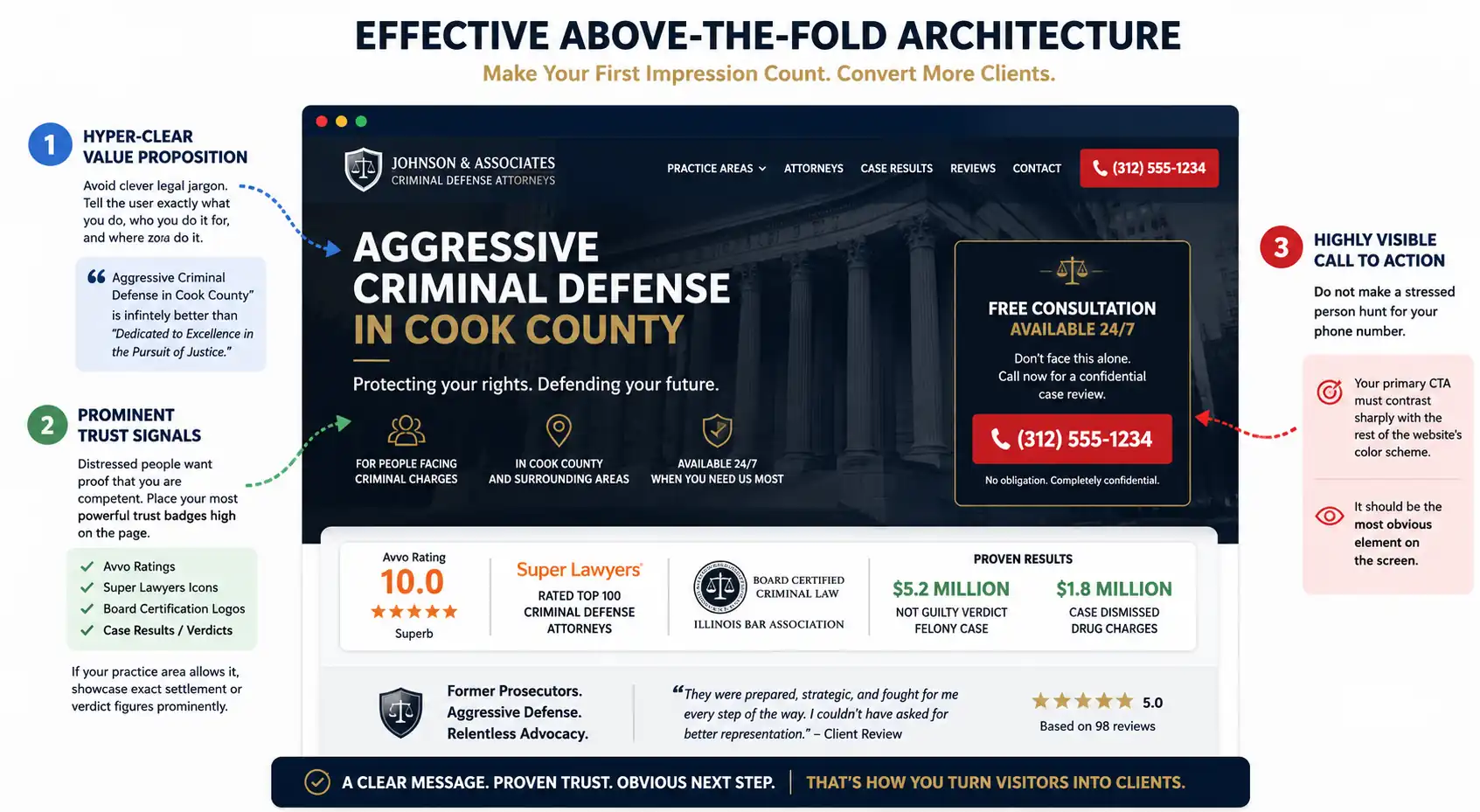
Effective above-the-fold architecture requires a prescriptive approach to visual layout.
Hyper-Clear Value Proposition: Avoid clever legal jargon. Tell the user exactly what you do, who you do it for, and where you do it. “Aggressive Criminal Defense in Cook County” is infinitely better than “Dedicated to Excellence in the Pursuit of Justice.”
Prominent Trust Signals: Distressed people want proof that you are competent. Place your most powerful trust badges high on the page. Display Avvo ratings, Super Lawyers icons, or board certification logos. If your practice area allows it, showcase exact settlement or verdict figures prominently.
Highly Visible Call to Action: Do not make a stressed person hunt for your phone number. Your primary CTA must contrast sharply with the rest of the website’s color scheme. It should be the most obvious element on the screen.
When a user sees a clear message, proof of authority, and an easy way to get help, their anxiety drops. You have secured their visual trust. The next step is perfecting the actual mechanics of how they reach out to your firm.
Eradicating Friction: Streamlining the Intake Journey to Capture High-Value Cases
Many elite law firms still rely on outdated, lawyer-centric intake practices that destroy their digital ROI. The most common offender is the complicated contact form. Many firms demand a first name, last name, email, phone number, zip code, and a detailed description of the legal issue.
This interrogates the prospect before they have even spoken to a human being. The result is massive form abandonment. You must eradicate friction from the intake journey. Data-driven CRO methodology proves that reducing the number of form fields directly increases the volume of leads submitted.
You should utilize a gated or tiered approach to forms. Ask only for a name, a phone number, and a single dropdown menu regarding their legal issue. Once your intake team has them on the phone, you can gather the granular details required for a conflict check. Your website is a tool to initiate conversations, not a paralegal tasked with conducting a full deposition.
Furthermore, you must offer multi-channel communication to match the user’s preference.
Sticky Click-to-Call Buttons: Ensure your phone number remains visible and clickable at all times as the user reads your content.
24/7 Live Chat: Many users are browsing for a lawyer from work, from a hospital bed, or in the presence of a spouse they intend to divorce. They cannot speak aloud. A live chat feature captures these high-value, silent leads.
SMS Integration: Allow users to text your firm directly from the website. Modern consumers prefer text over phone calls, and catering to this preference drastically boosts conversion rates.
While a frictionless intake process works wonders on a desktop computer, the reality is that the vast majority of today’s distressed legal searches happen elsewhere.
The Mobile-First Mandate: Capturing the On-the-Go Legal Consumer
Mobile optimization is no longer a secondary consideration. It is the primary battlefield for legal lead generation. If you practice in immediate-need areas like DUI, Criminal Defense, or Auto Accidents, your prospects are overwhelmingly searching for you on their mobile devices. They are standing on the side of a highway or sitting in the back of a police cruiser.
If your website forces them to pinch and zoom to read your phone number, they will hit the back button. The mobile mandate requires technical precision and a deep understanding of mobile user behavior.
Specific mobile CRO requirements include ruthless page speed optimization. A mobile legal page must load in under three seconds. Every millisecond of delay directly correlates to a massive drop in conversion rates. When people are panicked, they do not wait for bloated images or heavy videos to load.
Navigation must be entirely thumb-friendly. Dropdown menus that work beautifully on a desktop often become frustrating traps on a smartphone screen. You must streamline the mobile menu to present only the most critical practice areas and contact options.
Legible typography is non-negotiable. Fonts must scale appropriately for small screens so the user can absorb your value proposition instantly. Most importantly, your site must feature persistent header CTAs. A brightly colored phone icon must anchor to the top or bottom of the screen, following the user continuously as they scroll through your content.
Implementing these advanced structural, psychological, and technical changes is incredibly complex. It requires specialized expertise that goes far beyond standard web design.
Beyond the Clicks: How Blue Media Marketing Law Transforms Websites into Lead-Generation Machines
This is where the standard SEO approach fails and specialized legal marketing execution takes over. Blue Media Marketing Law does not just chase vanity traffic. We build end-to-end digital ecosystems designed specifically to maximize law firm ROI and secure high-value cases in the most saturated markets in the country.
Our comprehensive methodology attacks the conversion problem from every angle. We deploy advanced heat mapping technology to see exactly where your potential clients are clicking, scrolling, and losing interest. We remove the guesswork from website design by relying on hard data rather than aesthetic opinions.
We aggressively utilize A/B split testing on your most critical practice area pages. We will pit two different headlines, button colors, or form layouts against each other to see which version actually puts more signed retainers in your filing cabinet.
Blue Media Marketing Law provides bespoke user experience design tailored explicitly for the legal consumer’s mindset. We integrate our elite SEO and PPC services with rigorous CRO tactics to ensure that when we drive a hundred-dollar click to your website, that user is funneled seamlessly into your intake department. We transform static digital brochures into aggressive lead-generation machines designed to outsmart your local and national competition.
Stop Subsidizing Your Competitors: Secure Your ROI with Advanced CRO
Driving expensive, hard-earned traffic to a poorly optimized website is effectively paying for your competitors to acquire new clients. Every time a frustrated user bounces from your slow, confusing homepage, they take their high-value case to the firm right below you in the search results.
Traffic is only the first half of the battle. If your digital marketing strategy ignores the psychology and mechanics of conversion, you are burning capital every single month. It is time to stop subsidizing your rivals and start demanding a return on your marketing investment. Stop leaving lucrative cases on the table. Secure your market share by scheduling a comprehensive website audit and strategy session with Blue Media Marketing Law today.