

Understandably, law firms focus on investing in marketing initiatives that include a combination of strong branding, high-quality content, and compelling messaging. However, these normally effective tools and resources will inevitably fall flat if the website itself has a weak foundation. Unfortunately, even the best legal content is doomed to fail if it’s implemented on a broken system. Behind-the-scenes performance truly matters for search engines because they rely on a multitude of signals to determine top result placements online. If your law firm’s website loads slowly, fails simple indexing checks, or isn’t optimized for mobile use, all the quality content possible still won’t help you rank.
Integrating Technical SEO is Key
This combination of factors makes technical SEO for law firms extremely important. At Blue Media Marketing Law, we know that it’s a non-negotiable when it comes to providing law firms with sustainable visibility online. Google is set up to prioritize site security, crawlability, mobile responsiveness, and experience metrics. These days, these are just as important as backlinks and keywords to your site’s success. As a competitive law firm, you need your website to be technically sound, mobile-focused, fast, and secure to keep pace in the modern search landscape. Our team is here to help make that happen.
Technical Breakdown
Technical SEO can certainly seem complex on the surface. Breaking it down can help firms understand why it’s so vital to their overall marketing strategy.
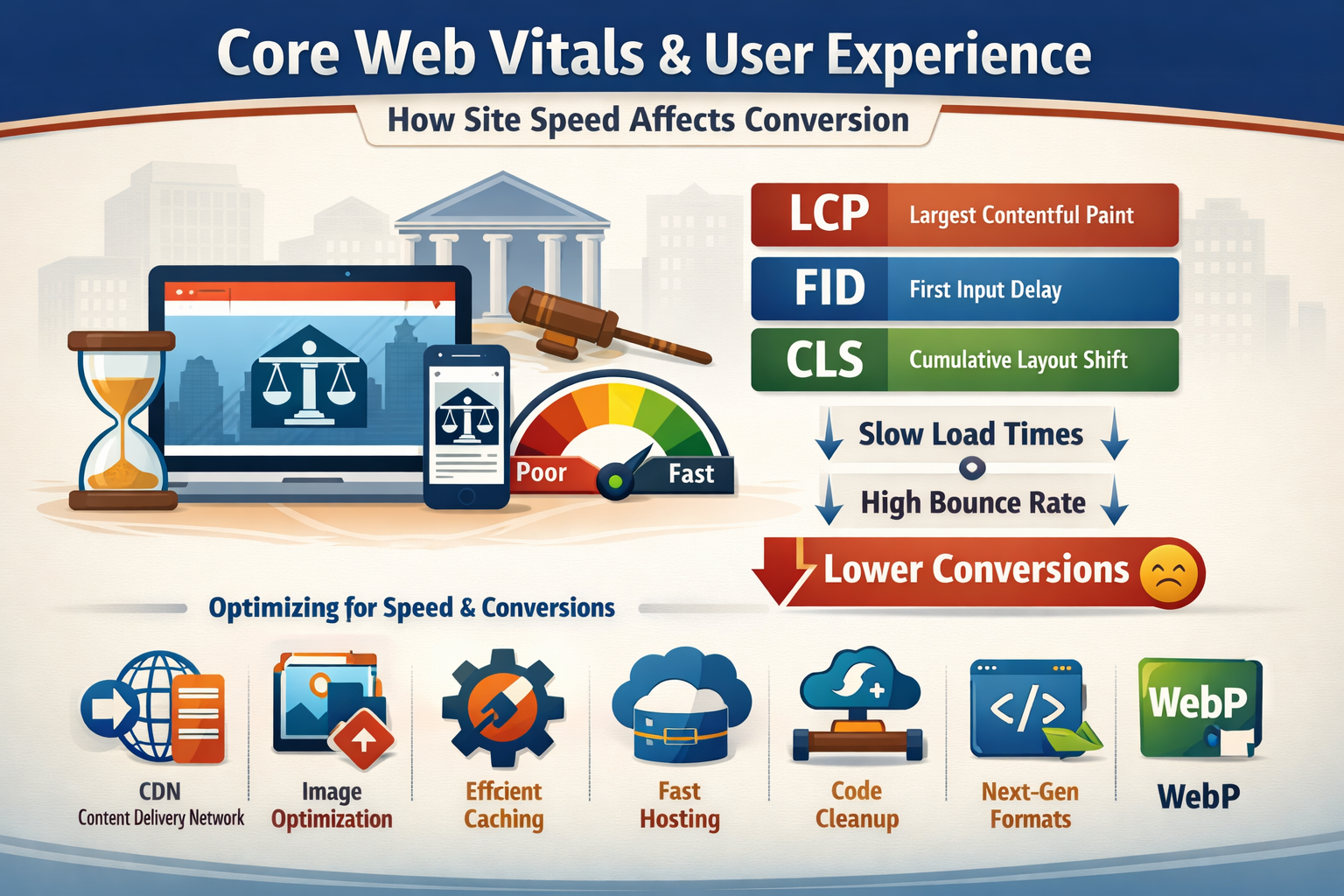
Core Web Vitals and User Experience : How Site Speed Affects Conversion
These days, Google’s Core Web Vitals are central to successfully optimizing legal websites. In fact, they have the power to directly influence rankings and conversions alike. These are the metrics that measure how stable your website layout is by evaluating factors like site loading speed and how quickly users can interact with your pages. This is especially important for law firms, because those who are searching for legal information online are often doing so in times of great stress. Whether they’re searching for legal assistance for a family dispute, injury, immigration issue, or after an arrest, your site needs to be quick, efficient, and informative to keep them engaged. Core Web Vitals can include:
- First Input Delay (FID)-A measurement of how quickly users can interact with your website
- Largest Contentful Paint (LCP)-A measurement of how quickly the main content on your website loads
- Cumulative Layout Shift (CLS)-A measurement of how stable the overall page layout is for users
If one or all these metrics fall below Google’s currently established thresholds, your bounce rates will spike, and your rankings will inevitably fall. Google isn’t in the business of rewarding slow site signals or poor user experiences. This means website speed for lawyers is much more than just a passing technical detail to contemplate. It’s an essential factor that can heavily influence overall conversion rates. To that end, pinpointing common causes of poor Core Web Vitals is a must. Oftentimes, this comes back to aesthetics. Many law firms lean into page builders and heavy themes that might look polished on the surface, but don’t perform well under the microscope of Google’s metrics. These could include:
- Unoptimized code
- Bloated plugins
- Outdated hosting
- Oversized site images
At Blue Media Marketing Law, we know what it takes to remedy the situation. Our approach to improving Core Web Vitals for law firms often starts with:
- Implementing a content delivery network (CDN)
- Compressing and resizing images as needed
- Utilizing next-gen formats such as WebP
- Integrating server-side caching
- Cleaning up unused plugins and scripts
- Upgrading to faster overall hosting
These are strategic improvements that allow a law firm’s website to load more quickly, rank higher, and enjoy higher engagement numbers. With a fast and stable website in place, you can look forward to measurable and exciting progress ahead.
Site Security (HTTPS) and Legal Data Privacy-The Non-Negotiable Trust Signals
In general, security is considered one of the strongest trust signals Google evaluates. This is a trust signal that really carries a lot of weight for law firms in particular. As clients share information regarding finances, immigration status, medical history, or their criminal past, your firm’s site needs to have specific protocols in place to protect that sensitive information. If it doesn’t, Google and your prospective clients alike will understandably view it as a huge risk.
That’s what makes HTTPS encryption so important. It’s the firm foundation of website security, and Google uses it as a ranking factor as well. Without it, your firm’s site is likely to be pushed down further in the search results, because it’s deemed unsecure and highly likely to deter users. In addition to HTTPS encryption, law firms should also consider the importance of implementing:
- Malware scanning
- Secure hosting environments
- Regular software updates
- Firewall protection
- Encrypted contact forms for prospective clients
- Full compliance standards with state and federal privacy laws
Encryption is especially important for legal websites that regularly collect personal information from searchers. This information can be obtained through consultation requests, chat tools, or intake forms. If your site doesn’t utilize the proper encryption techniques, your client’s data can easily be exposed online. Google is set up to detect these points of vulnerability and can ultimately reduce visibility to your site as a way of protecting consumer privacy. On the other hand, when law firms have strong security and encryption systems in place, it communicates reliability to clients and Google alike. This is a must for reaching clients in practice areas like:
- Immigration
- Personal injury
- Employment law
- Family law
- Criminal defense
The good news is that improving law firm site security doesn’t have to be overwhelming. There are straightforward steps to elevate privacy standards such as:
- Updating CMS platforms and plugins
- Integrating spam protections
- Adding security headers to your website
- Installing SSL certificates
- Utilizing secure hosting with active monitoring in place
- Encrypting all form submissions
Taking time to make sure these measures are in place will improve your rankings and create an atmosphere of higher trust with legal searchers online. It can also lend itself to stronger conversion rates over time.
Mobile-First Indexing-Reaching Clients in Their Moment of Need
In a world on the go, many legal searches these days happen at the touch of a button. Mobile devices are where most searchers look for immediate legal information when they have a family emergency, find themselves injured, or have been pulled over. This makes mobile-first indexing extremely important for your firm’s website. Google has also recognized the shift and now evaluates the mobile version of your site ahead of the desktop version. That means that if your mobile site version is faulty, difficult to navigate for users, or slow, your rankings will suffer as a result, even if your desktop site is pristine. Mobile-first indexing evaluates your site based on:
- Responsive page layouts
- Page load speeds
- Readable text sizes for mobile devices
- Proper spacing and navigation
- Mobile-optimized images
- Tap-friendly buttons
Typically, law firms have websites in place that lean heavily into complex layouts, heavy design elements, and oversized images. This can certainly make it difficult to transition to an efficient mobile performance site. Understanding the changes that need to take place can help with the adjustments. To that end, a strong mobile experience requires:
- Easy-to-read content for users
- Simple navigation setup
- Fast load times on all pages
- Streamlined forms
- Clear calls to action
- Click to call functionality
Combined, these elements are shown to help users looking for legal assistance on their mobile device act quickly. Mobile-first indexing is also something that directly affects how Google ranks your pages. In the event your mobile site version loads slowly, or hides content, Google won’t be able to index your most important pages accurately. Improving the performance of your site on mobile devices and boosting your rankings starts with:
- Eliminating intrusive pop-ups
- Reducing image sizes
- Using lightweight themes
- Simplifying page menus
- Ensuring your design is responsive
When integrated correctly, mobile optimization can really help law firms see higher engagement numbers with prospective clients. You’ll find your firm is quicker to show up at the top of search results, and more calls lead to higher conversions.

Indexability and Crawl Budgets-Ensuring Google Doesn’t Miss Your Most Important Pages
Investing in high-quality content is important for establishing the credibility of a law firm’s website. However, it doesn’t do much if that information can’t easily be found online. The information your firm is posting needs to be easily identifiable to be properly ranked by Google. Indexability and crawl budgets often determine how efficiently search engines find, evaluate, and store your pages in the long run. That makes legal site optimization a critical part of the process, and especially important for firms that have multiple practice areas, location pages, and attorney profiles to showcase. As Google assigns each website a “crawl budget,” it determines the number of pages it will crawl in a certain timeframe. Websites that are error-packed, cluttered, or slow will see Google focusing time on unimportant pages, leaving key content entirely unseen. Some of the most common crawl-related issues law firms encounter on their sites include:
- 404 errors
- Duplicate content
- Blocked resources
- Unoptimized sitemaps
- Redirect chains
These issues may seem minor on the surface, but when they accumulate, Google struggles to index your site at all over time. This makes it important for a well-structured law firm website to have:
- Fast server response times in place
- Clear URL structures
- Complete and logical internal links
- Minimal duplicate content
- A clean sitemap
Websites with outdated or incomplete sitemaps are especially problematic. That’s because they’re designed to be roadmaps for Google pointing to pages that are most important. If they aren’t working property, Google can miss critical practice areas and attorney profiles, leaving your site far out of reach of high-value clients you’re looking to appeal to. Similarly, broken page links make it difficult for Google to understand your website’s hierarchy of content. Crawl errors like 404s frustrate users and waste crawl budget. To improve indexability on this front, it’s important to take time to take a few essential steps. These include:
- Running a comprehensive technical audit of your website
- Updating sitemaps
- Fixing all broken links
- Adding internal links to key pages
- Removing duplicate pages
- Improving server performance
Auditing Your Site for 2026 Performance Standards
It’s fair to say that technical SEO is evolving quickly. Law firms must keep up with Google’s evolving expectations as well. Moving into 2026, performance standards have certainly risen to new heights. This requires websites to showcase secure connections, clean indexing, mobile-first designs, and fast load times.
These are no longer features that are simply put in place so firms gain a competitive edge. Instead, they’ve become baseline requirements for success. That makes a comprehensive technical audit a must-do this year. An audit sheds light on hidden issues that could be holding your rankings back from their true potential. It’s a way to ensure your site has a firm technical foundation, so the content you invest in is also easy to reach by searchers. When it’s higher conversions you’re after and stronger long-term visibility you seek, a technical audit is the way to go in 2026. Reach out to Blue Media Marketing Law today to learn more.